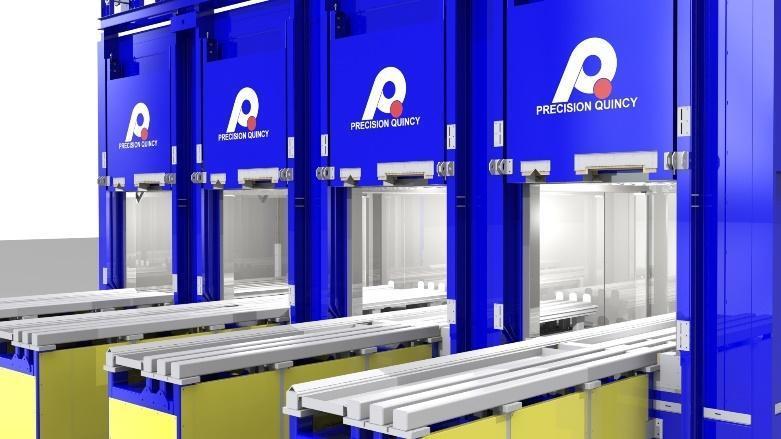

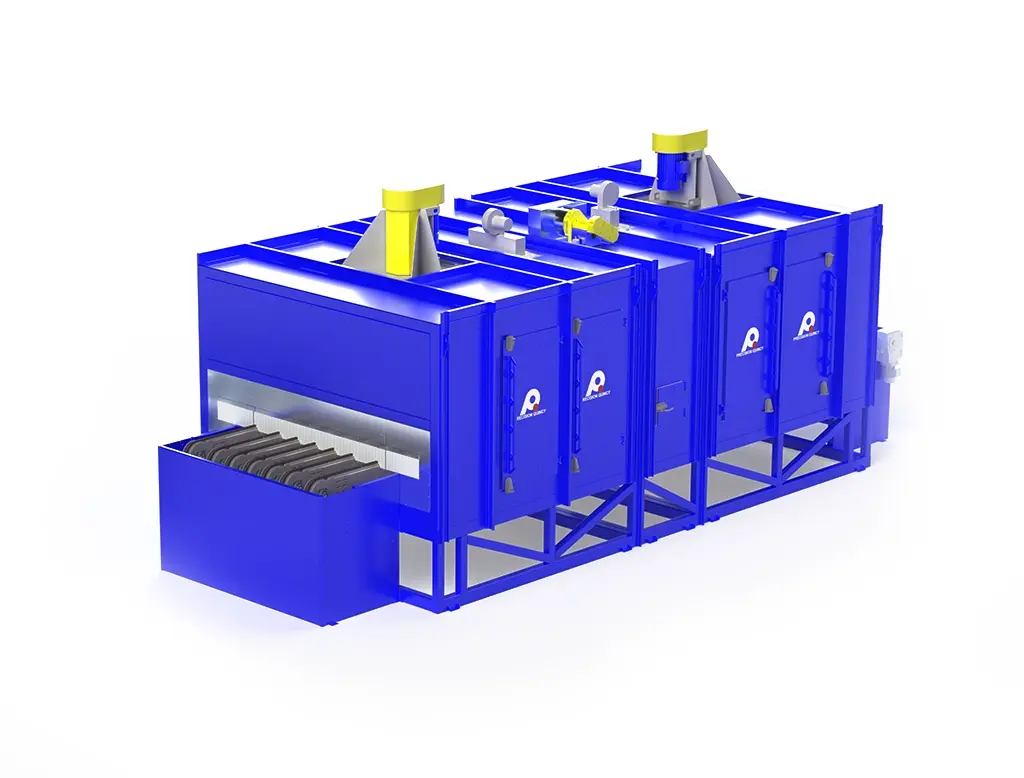
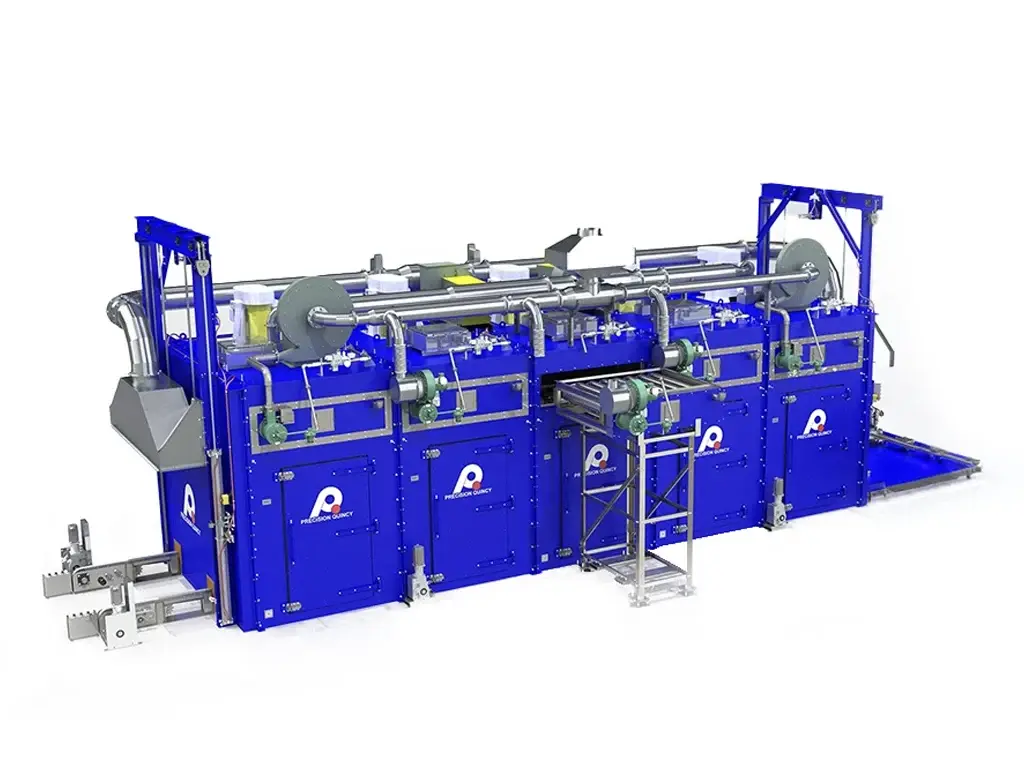
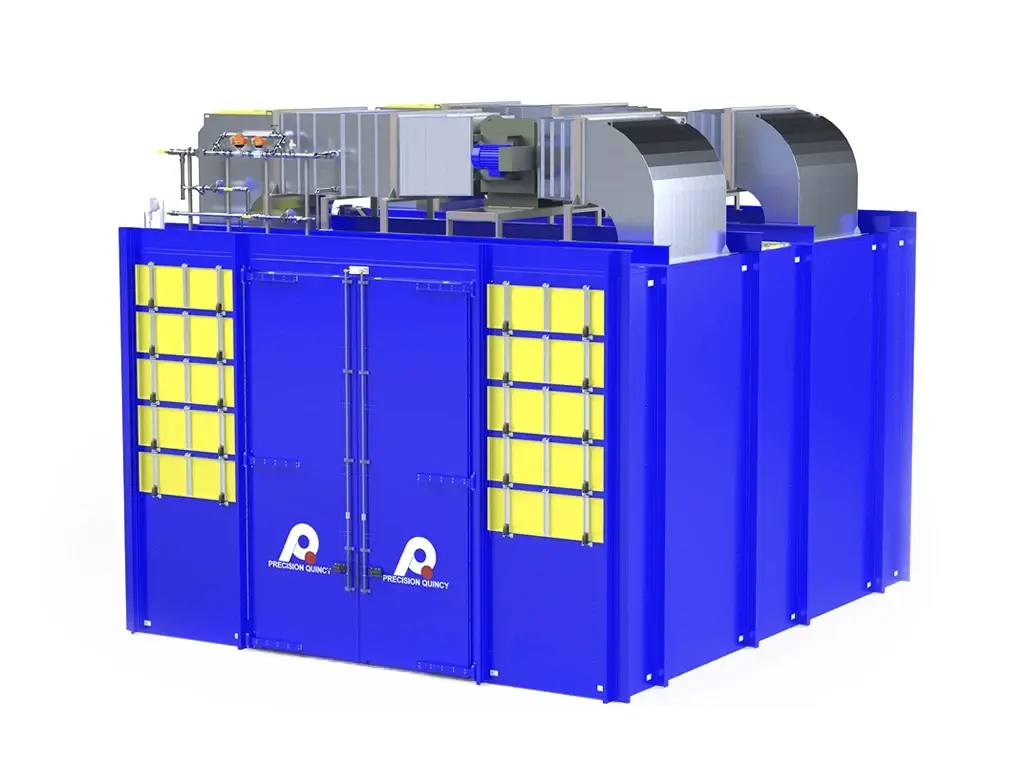
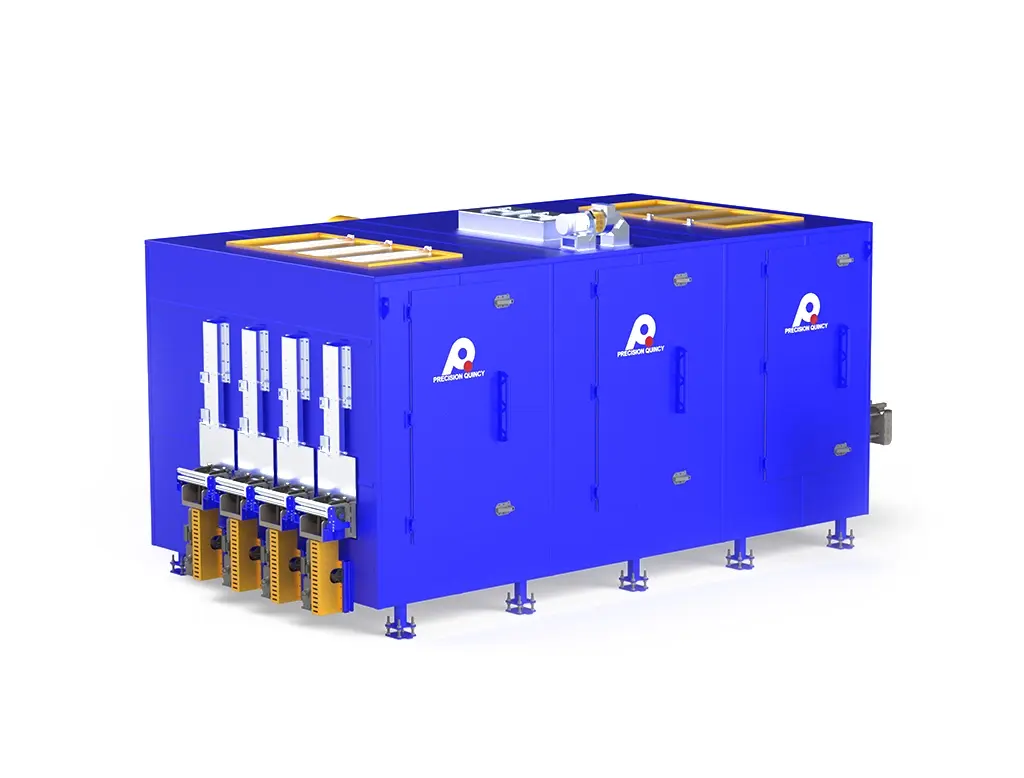
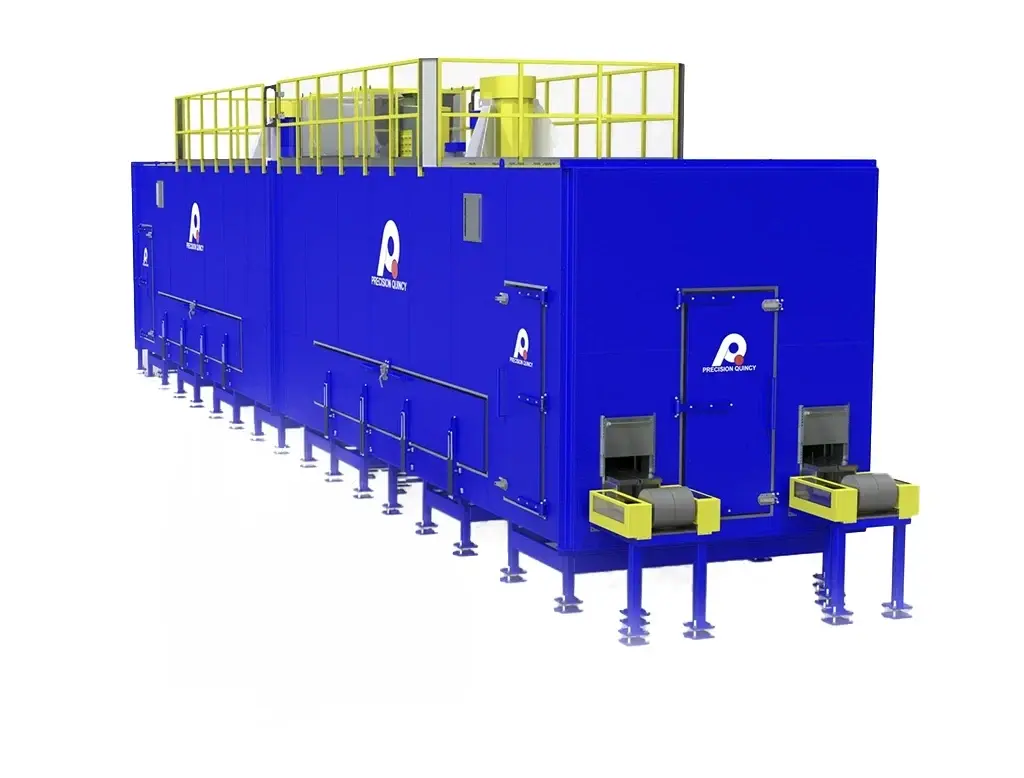
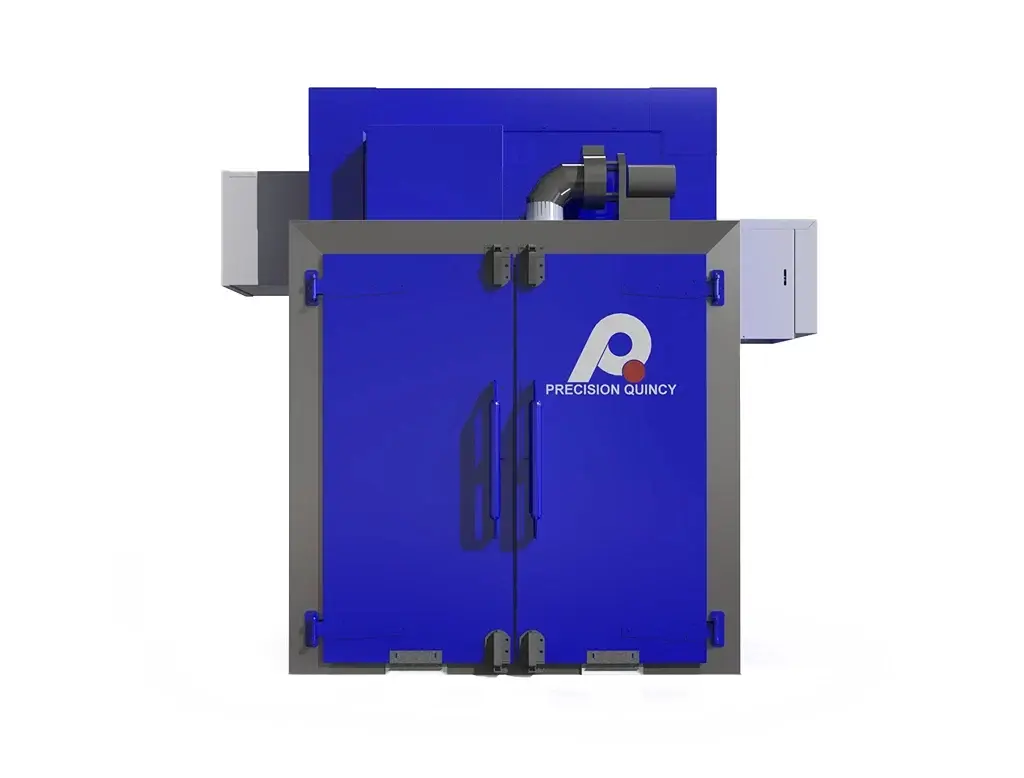
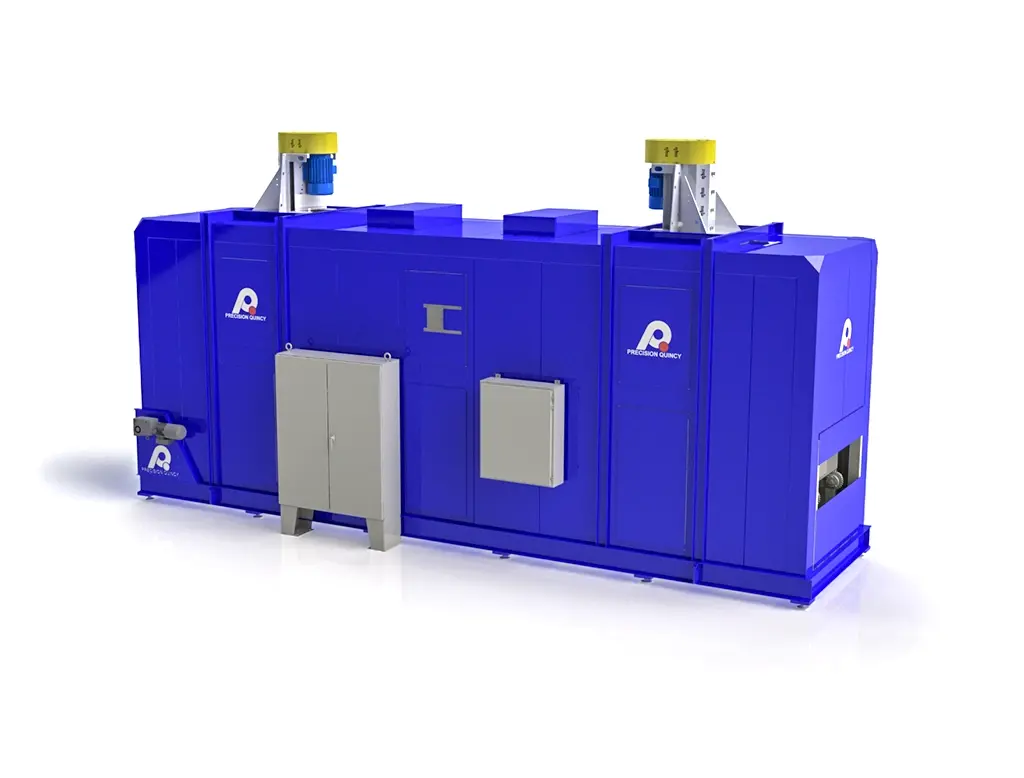
Three-Zone Edge-Focused Continuous Curing Oven – 152,000 lb/hr
Key Takeaways
- Engineered a three-zone, single-path continuous curing oven that concentrates heat transfer on painted board edges instead of wasting energy on already-wrapped top and bottom faces
- Delivered approximately 152,000 lb/hr of throughput across a wide product mix and width range (~1.5 in. to 12 in.)
- Used edge-focused, vertical-down airflow to cure coatings without disturbing or shifting the product; ⅜-in. slot nozzles deliver 5,800 FPM ±870, perpendicular to the oven length
- Met a low-NOx corporate standard with three Maxon OvenPak LE15 burners (4.8 MMBtu/hr total) and servo-driven SmartLink MRV emissions control mapped to hold NOx < 30 ppm
- Solved the low-NOx turndown challenge with a wide-range exhaust system (3,945–15,750 CFM) on VFDs and modulating dampers to stabilize low-temperature operation
- Fit the full solution within the customer’s fixed 377-in. installation envelope and engineered it to ship as three bolt-together zone sections
When a curing oven sits inline inside a larger production cell, it can’t be the part of the line that sets the pace. For us, that starts with a simple assumption: the oven isn’t just equipment that adds heat. It has to disappear into the process: hold its profile, keep product moving, and direct energy exactly where the coating needs it — and nowhere else.
If the oven drifts out of profile or can’t keep up with the line, the whole cell suffers.
On this project, a major North American building-products manufacturer came to Precision Quincy with a high-volume trim finishing challenge. After trim boards are cut to size, their exposed edges are painted, and that edge paint has to be dried and cured at full production rate. The boards themselves are already wrapped on the top and bottom surfaces, so heating those faces does nothing but waste energy. The real task was to concentrate heat transfer precisely on the edges while moving an enormous amount of product through a fixed footprint.
The Challenge
The throughput and footprint requirements were already demanding on their own. The second constraint added an engineering challenge: the customer’s corporate standard required low-NOx burners.
The catch is turndown. Low-NOx burners limit how far combustion can be reduced, which makes stable low-temperature operation — 200°F to 300°F on a lightly loaded or empty line — difficult to hold. The oven still needs full high-temperature capability for heavier product.
Both requirements have to coexist on the same system.
The system needed to:
- Process ~152,000 lb/hr of edge-coated trim boards across a width range of ~1.5 in. to 12 in.
- Concentrate heat on the painted board edges only — wrapped top and bottom surfaces don’t need heat
- Hold ±10°F uniformity from setpoint at the nozzle discharge across the 200–300°F operating range
- Meet a low-NOx corporate standard (NOx < 30 ppm) without losing stable low-temperature control
- Fit the full solution inside a fixed 377-in. installation footprint
- Ship as discrete sections for predictable field installation inside an existing production cell
Getting clean combustion at low NOx and stable low-temperature control on the same system, without sacrificing high-temperature capability for heavier loads, was the engineering knot at the center of this build.
Heating only what needs heat
The defining constraint on this build wasn’t temperature or even throughput in isolation — it was where the energy goes. The trim travels widthwise through the system (“wide way in,” boards oriented with their length perpendicular to the direction of travel), and only the cut edges carry wet coating. Wrapped top and bottom surfaces don’t need heat; adding it there is wasted energy and wasted capacity.
So we treated the airflow as a targeting problem. Conditioned air is delivered straight down from overhead nozzles, focused at the board edges, with airflow direction running perpendicular to the oven length.
The system also had to accommodate a wide product width range — roughly 1-½ in. to 12 in. — while still directing heat where it’s needed and without disturbing the product. Boards can’t drift laterally, hop, or get pushed around by the very airflow that’s curing them.
The engineering approach
The thermal process requirements here were jointly developed — a combination of Precision Quincy testing, customer process experience, and our prior work with similar product lines — rather than lifted from an existing oven. That mattered, because almost every requirement on this project pulled against another one.
Our approach was to treat airflow, conveyance, heating, and exhaust as one integrated system instead of four features bolted together:
- Start with the coating and the edge geometry, and precisely define the heat transfer needed for the cure
- Lock in the operating window (200–300°F normal, 450°F maximum capability) and the time-in-heat range demanded by the product mix
- Build the airflow delivery, motion system, heating, and exhaust control around those needs — inside a footprint that couldn’t expand
The goal wasn’t simply to “dry the paint.” At roughly 152,000 lb/hr, throughput is the primary requirement. Line speed is secondary: whatever speed it takes to hit the mass rate target for a given product mix. That kind of rate offers no slack — so zones, airflow, conveyor, and controls all have to hold together within a narrow process window.
Project at a glance
- Application: Drying and curing edge-applied (non-VOC) coatings on cut wood/composite trim boards
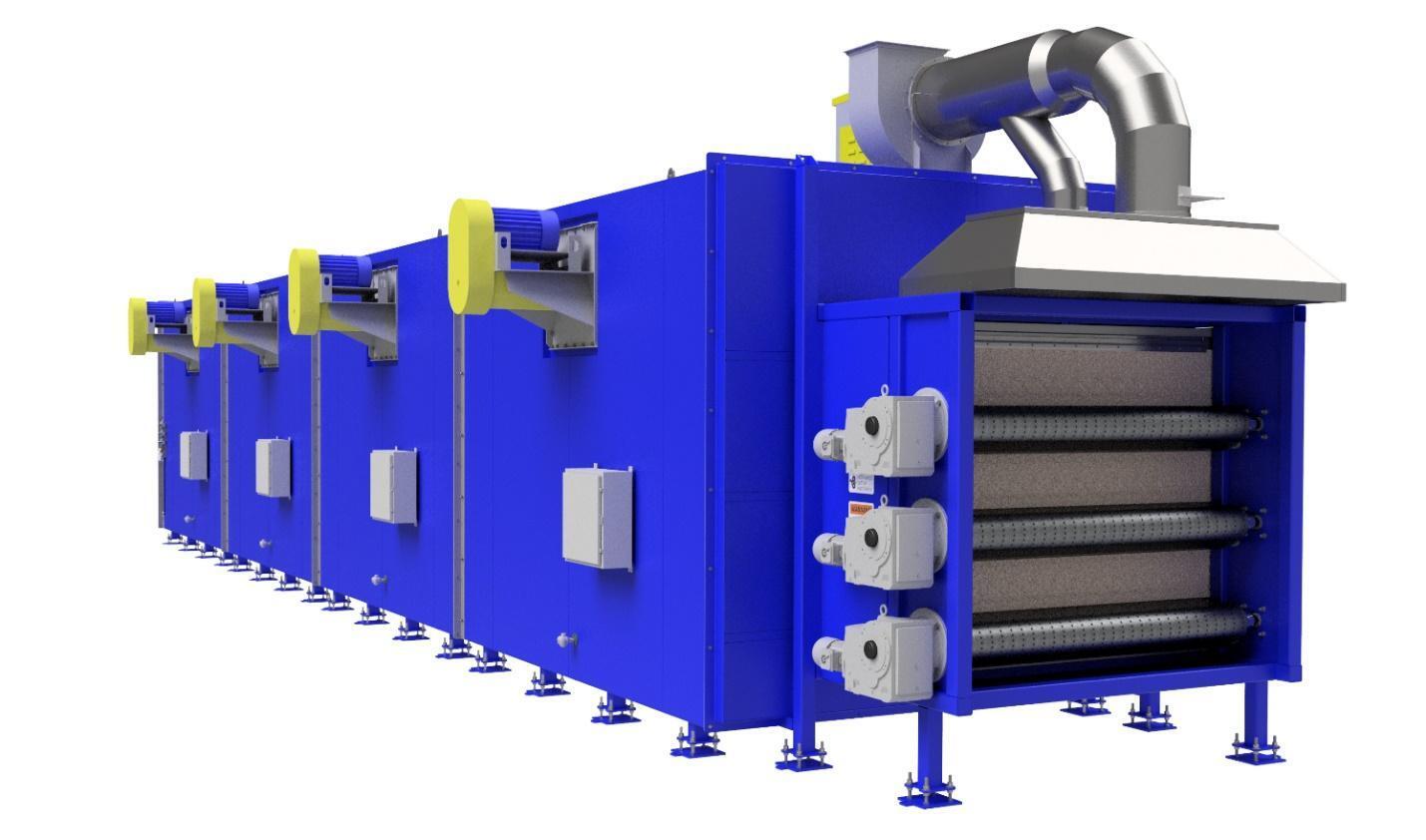
- System: Three-zone, single-path continuous conveyor curing oven with edge-focused, vertical-down airflow
- Throughput: ~152,000 lb/hr across a wide product mix (mass throughput is the primary spec; line speed is secondary)
- Product range: Trim widths ~1½-in. to 12 in.; boards run “wide way in”
- Operating temperature: 200–300°F normal, 450°F maximum capability
- Uniformity: ±10°F from setpoint at the nozzle discharge
- Airflow: Vertical-down, edge-focused; 5,800 FPM ±870 through ⅜-in. slot nozzles, perpendicular to oven length
- Heating: Three Maxon OvenPak LE15 low-NOx burners, 1.6 MMBtu/hr each (4.8 MMBtu/hr total)
- Emissions control: Servo-driven SmartLink MRV (Maxon/Honeywell), mapped to hold NOx < 30 ppm
- Exhaust: 3,945–15,750 CFM total, VFDs + modulating dampers
- Conveyor: Six-strand RS60 steel roller chain on AR500 wear guides; adjustable up to 60 ft/min
- Compliance: NFPA 86 Class A
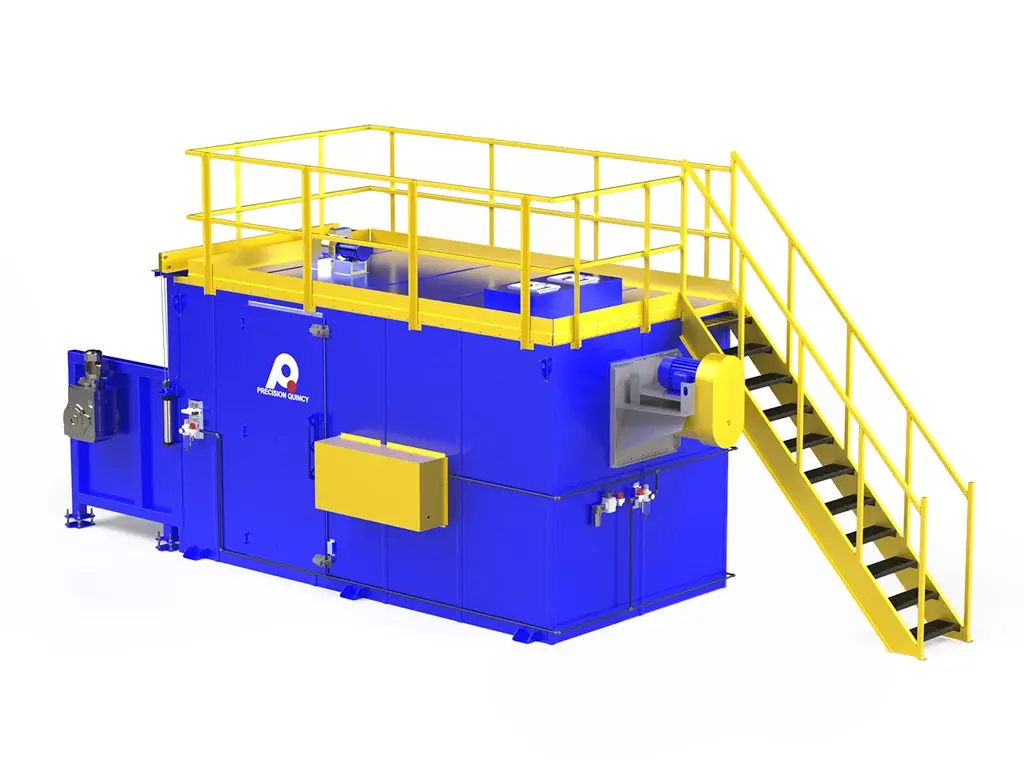
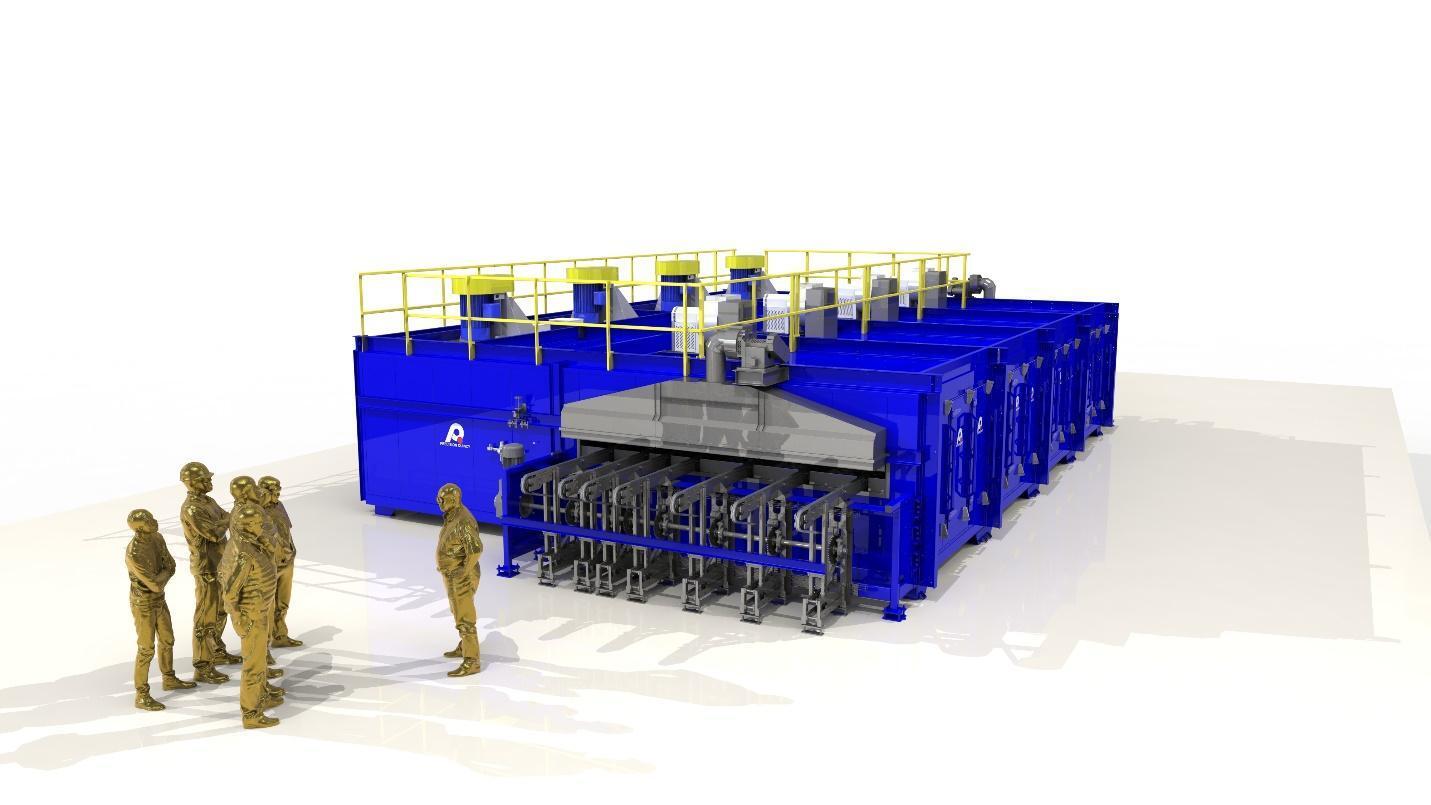
- Overall dimensions: 274 in. W × 377 in. L × 181 in. H; ships as three bolt-together zone sections
Execution and integration
Thermal performance can look right on paper and still fall short in production if the airflow path, conveyance, and exhaust aren’t engineered with the same rigor as the burners.
Edge-focused airflow: the Nautilus duct
Each of the three zones uses what we call a Nautilus duct arrangement. The recirculation fan shaft transitions from horizontal into a curved down-turn with turning vanes, then back to horizontal distribution, so discharge air exits the overhead nozzles straight down onto the product edges. Return air travels down the sides of each duct path, back up through the burner and heat section, and is re-delivered. It’s a closed, repeatable loop built to put the air exactly where the cure happens.
- Recirculation: 40-in. fan per zone moving 40,000 CFM at 3 in. w.c. (120,000 CFM total), driven by a 40 HP motor per zone (120 HP total)
- Nozzles: ⅜-in. slots delivering 5,800 FPM ±870 FPM, focused at the board edges
- Uniformity: ±10°F from setpoint at the nozzle discharge
Concentrating the air this way is how the system handles a 1½-in. board and a 12-in. board on the same line without overheating the wrapped faces or starving the edges.
Conveyance: supporting product at width, with minimal strands
Throughput is meaningless if the conveyor can’t carry product reliably across a 204-in. work width. The customer also wanted the strand count kept low to maximize value, so we engineered a six-strand RS60 steel roller chain with flat sidebar, positioned across the width — strands at 15, 47, 89, 122, 155, and 190 in. from one edge — on replaceable AR500 wear guides.
- Drive: A common shaft runs through all six strands to a single 5 HP gearbox, VFD-controlled, with speed adjustable up to 60 ft/min so time-in-heat can be tuned to product size
- Tensioning: Individual pneumatic tensioners per strand; no synchronized rack-and-pinion take-up to bind or fall out of sync
- Capacity: 2,200 lb evenly distributed across the conveyor, with a hot return path routed through the oven below the top chain plane
Replaceable wear guides and individually tensioned strands are deliberate reliability decisions: the wear items can be serviced without rebuilding the conveyor.
Low-NOx heating and the turndown challenge
The low-NOx requirement was the hardest knot in the build. Low-NOx burners deliver cleaner combustion — at the cost of limited turndown range. On a lightly loaded or empty line at a 200°F setpoint, that limit makes stable low-temperature operation difficult to hold without full high-temperature capability for heavier product.
We solved it on two fronts at once. Heating uses one Maxon OvenPak LE15 burner per zone (1.6 MMBtu/hr each, 4.8 MMBtu/hr total), with a servo-driven SmartLink MRV emissions control system mapped to hold NOx below 30 ppm. The burner fires upstream of the fan into a diffuser for mixing prior to fan pressurization. Then, instead of expecting the burner alone to manage low-temperature stability, we gave the exhaust a wide operating band — from a 3,945 CFM minimum up to 15,750 CFM — using VFDs and modulating dampers. That exhaust headroom enables the oven to shed heat and hold a stable low temperature under low-NOx turndown limits, while also removing drying moisture (up to 8 gal/hr water load) and products of combustion.
Controls, integration, and safety: built to live inside a larger cell
This curing module is not a standalone oven — it’s one machine in a two-machine production cell, integrated mechanically and through the controls with the equipment around it.
- PLC: Allen-Bradley CompactLogix controls this module and the adjacent paired equipment, with the control cabinet remotely located
- Drives: Yaskawa VFDs (customer-specified) on the fans, exhaust, and conveyor
- Burner safety: Karl Dungs-based safety system with Maxon/Honeywell burner control components
Compliance and safeguards include:
- NFPA 86 Class A design
- Explosion relief in the roof and sidewalls, and via access doors as applicable
- Ten access doors for fast side access — so an operator can clear a broken board inside the oven without full disassembly
- Full-length roof walkway with guard rails on roof areas not occupied by explosion relief, for safe service access
The shell is built around a structural steel frame, with free-floating 16-gauge aluminized interior pans that tolerate thermal expansion and contraction while minimizing through-metal, insulation outside those pans, and 16-gauge mild steel exterior cladding finished in a customer-specified light gray two-part epoxy.
Results
Beyond meeting the customer’s process specifications, we engineered the system to make a demanding, high-volume cure both efficient and serviceable:
- Reduced energy wasted on already-wrapped surfaces by concentrating heat transfer on the painted edges
- Delivered ~152,000 lb/hr across a wide product mix and a 1.5–12 in. width range on a single product path
- Held a tight process window — ±10°F at the nozzle discharge — across the 200–300°F operating range with 450°F capability in reserve
- Met the low-NOx corporate standard (NOx < 30 ppm) while solving the low-temperature turndown problem through wide-range exhaust control
- Fit the full solution inside the fixed 377-in. footprint and engineered it to ship as three bolt-together sections for predictable installation
- Equipment was fully tested and accepted via FAT at Precision Quincy, with the customer in attendance
Closing Thoughts From the Build
In thermal processing, “efficient” means something different on every project. For us, on this project, it had a specific definition: put the energy exactly where the coating is, move an enormous amount of product through a footprint that couldn’t grow, and do it under a low-NOx standard that creates constraints at low load — without the oven ever becoming the bottleneck in the cell.
What we’re most proud of isn’t any single component. It’s how the edge-focused airflow, the six-strand conveyance, the low-NOx heating, and the wide-range exhaust work together as one managed process. As a result, the line keeps moving and the cure stays in spec across a wide product mix.
Solutions like this reflect how Precision Quincy shows up for our customers: confident in the engineering, serious about craftsmanship, and focused on equipment that delivers consistent results long after installation.
Have a curing or thermal processing challenge? Reach out to the Precision Quincy team any time to talk through requirements, constraints, and what “efficient at full rate” needs to look like for your line.
You May Also Like
These Related Stories
Tailored Oven Systems by Precision Quincy Boost Manufacturing Efficiency in Auto Industry
Precision Quincy Designs Comprehensive System to Preheat, Cure and Cool Fiber Cement Trim and Boards