

Project Number: 5691
Electric Class A Truck Oven for Blade Curing in Aeroderivative Turbine Component Processing
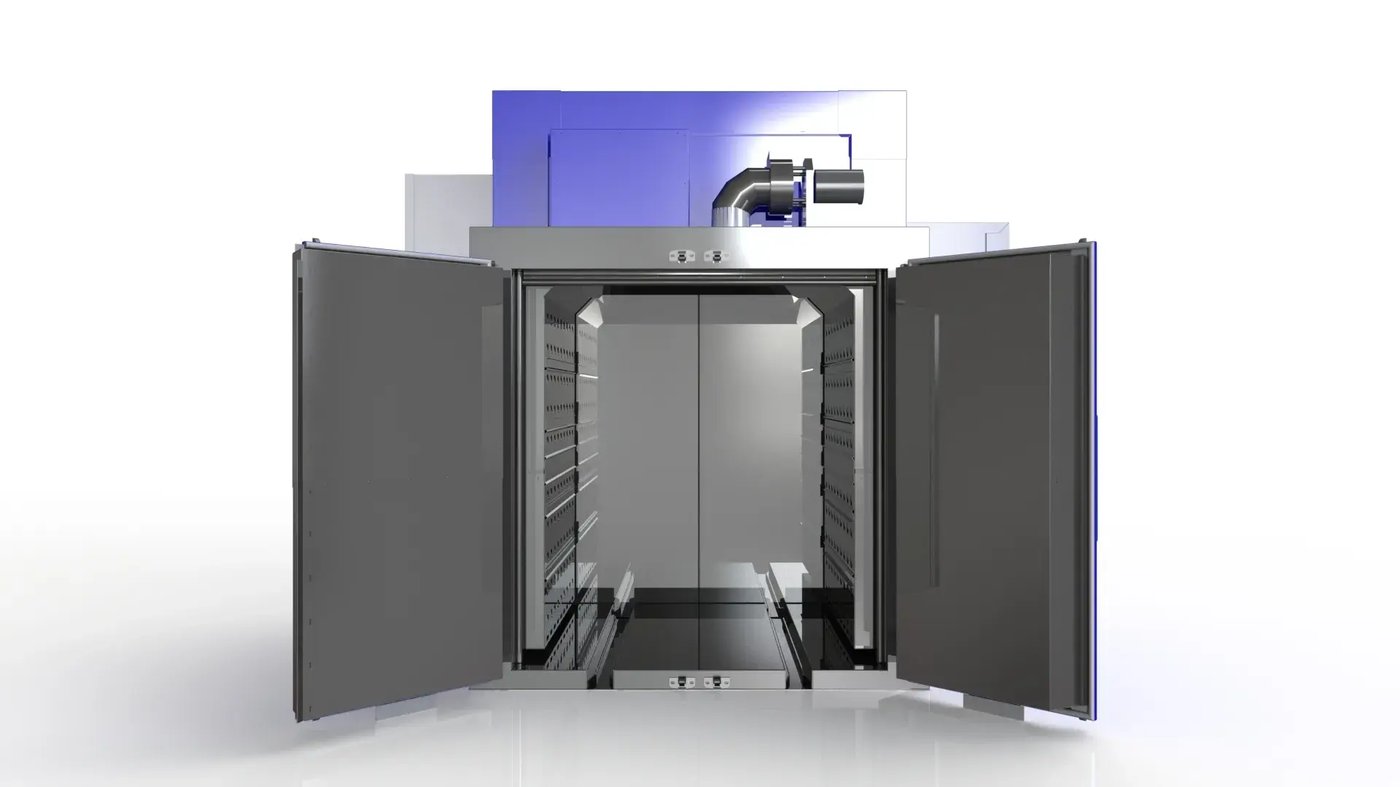
Overview
The customer operates in the aeroderivative power market, supporting turbine equipment, component processing, and lifecycle care for critical power assets. The project was developed to support blade-curing work within that environment, where repeatable thermal processing, controlled airflow, and disciplined safety logic are essential to consistent part quality.
The oven was built around a 48 in W x 48 in D x 60 in H work chamber and designed for an operating range of 600°F to 650°F, with a maximum temperature of 800°F and a required work-zone uniformity of ±10°F. The thermal package uses 54 kW of electric resistance heat, a full horizontal airflow pattern, a recirculation fan delivering 2,100 CFM at 2 in. W.c., and a PQ1 powered exhauster rated for 550 CFM at 1 in. W.c.
The final design package also incorporated a Watlow F4T ramp/soak controller, Type J thermocouples, a NEMA 1 UL508A open industrial control panel, and Class A purge and airflow-proving logic. The oven shell uses 6-inch insulated wall construction, an aluminized interior, and a traffic gray exterior finish, giving the customer a durable batch-processing platform for controlled blade-curing cycles.
The project was developed to support batch curing of blades in an aeroderivative turbine component environment. The customer needed a thermal-processing platform sized for blade-related work that required controlled curing temperatures, repeatable cycle management, and safe handling of a solvent-bearing Class A process.
APPLICATION REQUIREMENT
- The project required a batch curing oven for blades.
- The oven had to support thermal processing in a facility environment centered on aeroderivative turbine equipment and component work.
- The process required a machine format suitable for repeatable batch loading and unloading, rather than a continuous conveyorized system.
WORK CHAMBER / LOADING REQUIREMENT
- Required work chamber: 48 in W x 48 in D x 60 in H.
- The chamber had to accommodate blade-processing loads while preserving airflow across the work zone.
- Product and fixture positioning had to support clear airflow passage through the oven during operation.
QUALITY / CONTROL REQUIREMENT
- The customer needed repeatable curing performance within the stated work-zone uniformity.
- The process required programmable ramp/soak temperature control for defined thermal cycles.
- The system had to provide stable airflow, controlled heat delivery, and dependable batch-to-batch process repeatability.
SAFETY / ENVIRONMENTAL REQUIREMENT
- The oven had to be configured as an NFPA 86 Class A unit.
- The documented volatile-load basis required powered exhaust and purge logic.
- The process required heat to remain interlocked to proven safe operating conditions.
UTILITY REQUIREMENT
- Required electrical service: 460V / 3PH / 60Hz.
- Design elevation basis: below 1,000 ft.
The project required a controlled curing process built around elevated-temperature forced convection, programmable cycle control, and Class A ventilation.
TEMPERATURE REQUIREMENT
- Operating temperature basis: 600°F to 650°F.
- Maximum temperature capability: 800°F.
- Required work-zone uniformity: ±10°F.
AIRFLOW / HEAT-TRANSFER REQUIREMENT
- Airflow direction basis: full horizontal airflow.
- The process required forced-convection crossflow through the work chamber to deliver repeatable heat transfer across blade loads.
- Using the documented recirculation airflow and the chamber cross-sectional area in the airflow direction, the first-pass average chamber air velocity is approximately 105 FPM.
HEAT-INPUT REQUIREMENT
- Heat source: electric resistance heat.
- Installed heat basis: 54 kW total.
- Heating arrangement basis: two 27 kW heater banks.
- The process required staged heater-bank control to maintain the curing temperature window.
VENTILATION REQUIREMENT
- The process required Class A exhaust and purge sequencing.
- Maximum volatile load basis: 0.32 gal/batch o-xylene.
- Ventilation had to be proven before electric heat could be enabled.
CONTROL / SEQUENCING REQUIREMENT
- Primary control basis: ramp/soak temperature control.
- Minimum purge time basis: 3 minutes.
- Documented operating sequence:
- Start exhaust fan
- Start recirculation fan
- Complete purge
- Turn on heater bank(s)
- Run at temperature or programmed profile
COOLDOWN REQUIREMENT
- The process required continued fan operation during cooldown.
- The system operating basis requires fans to remain on until oven temperature drops below 250°F.
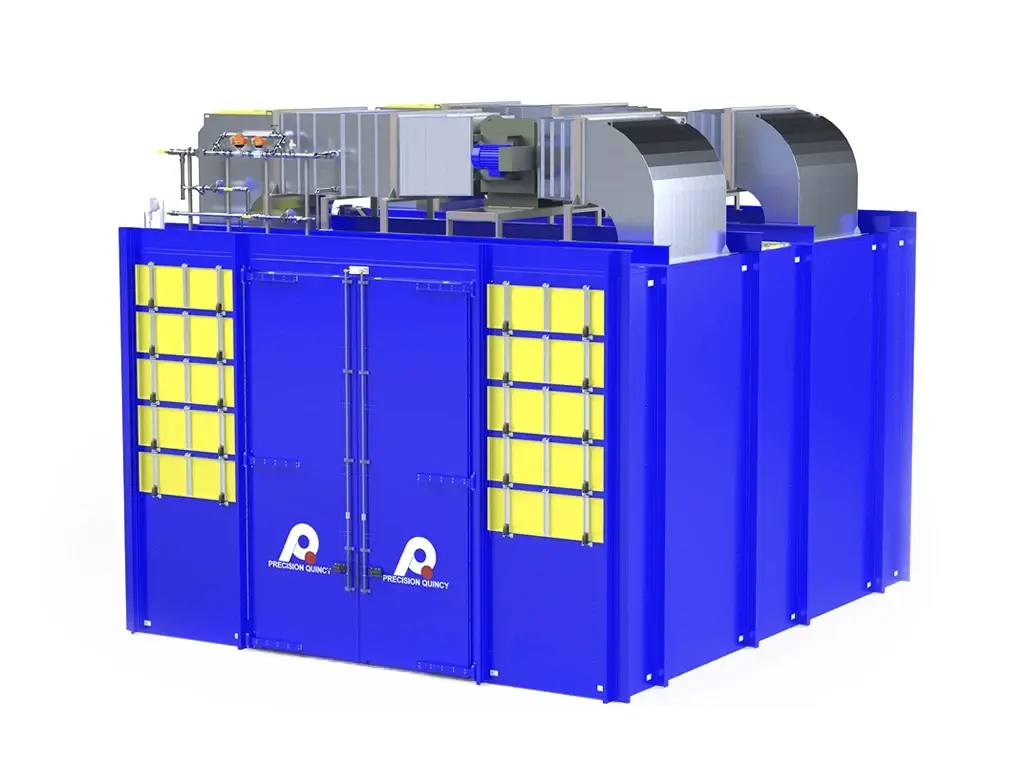
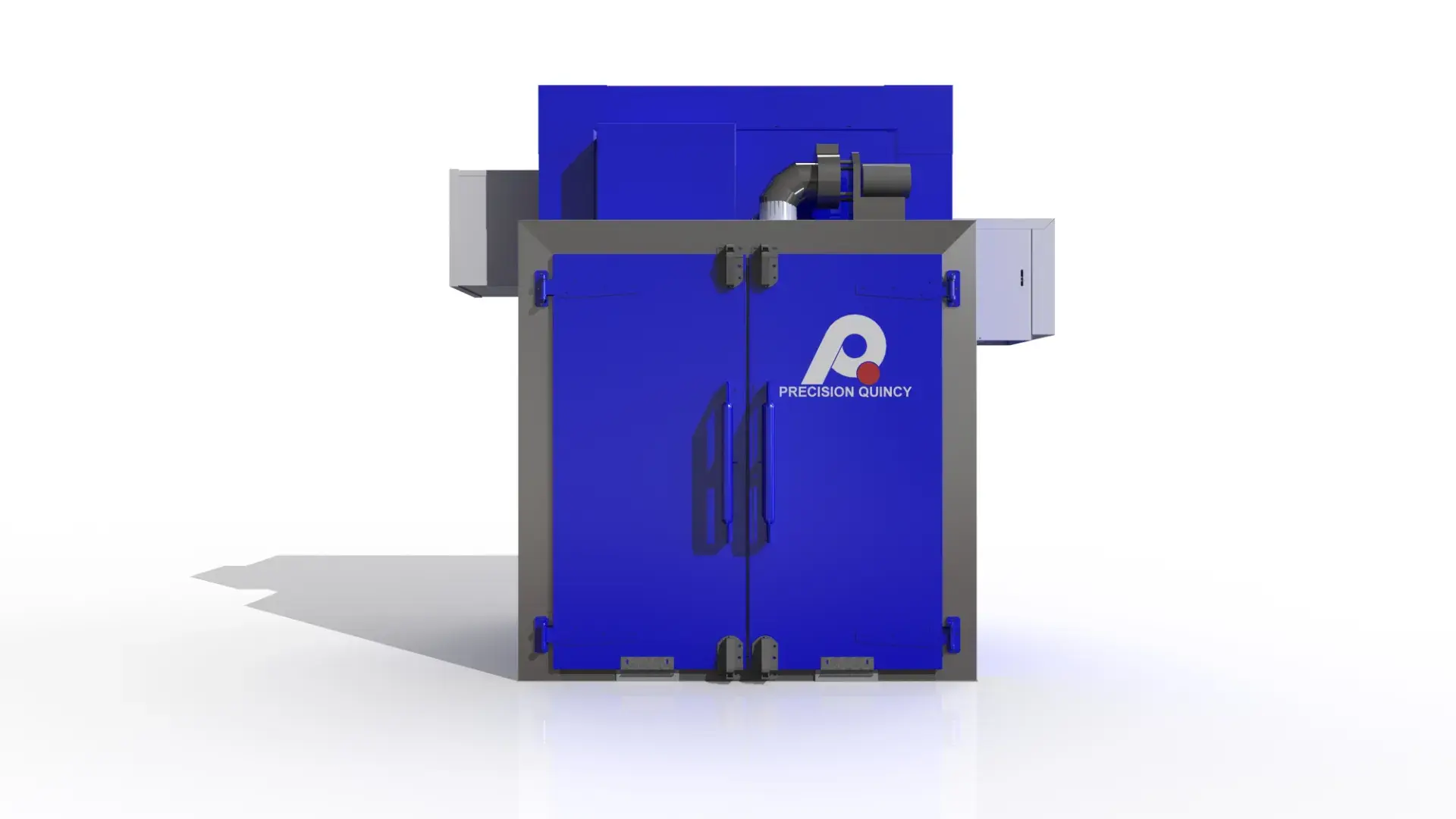
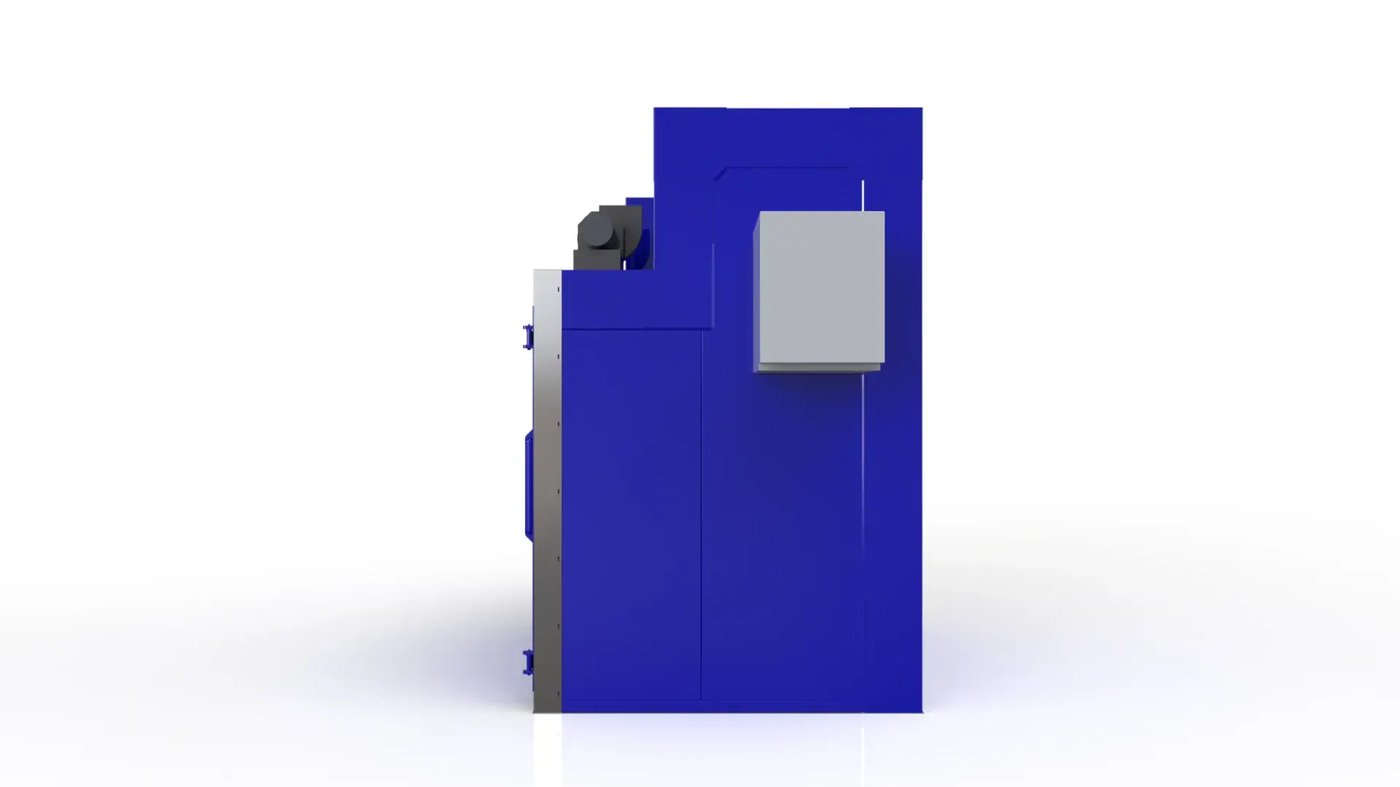
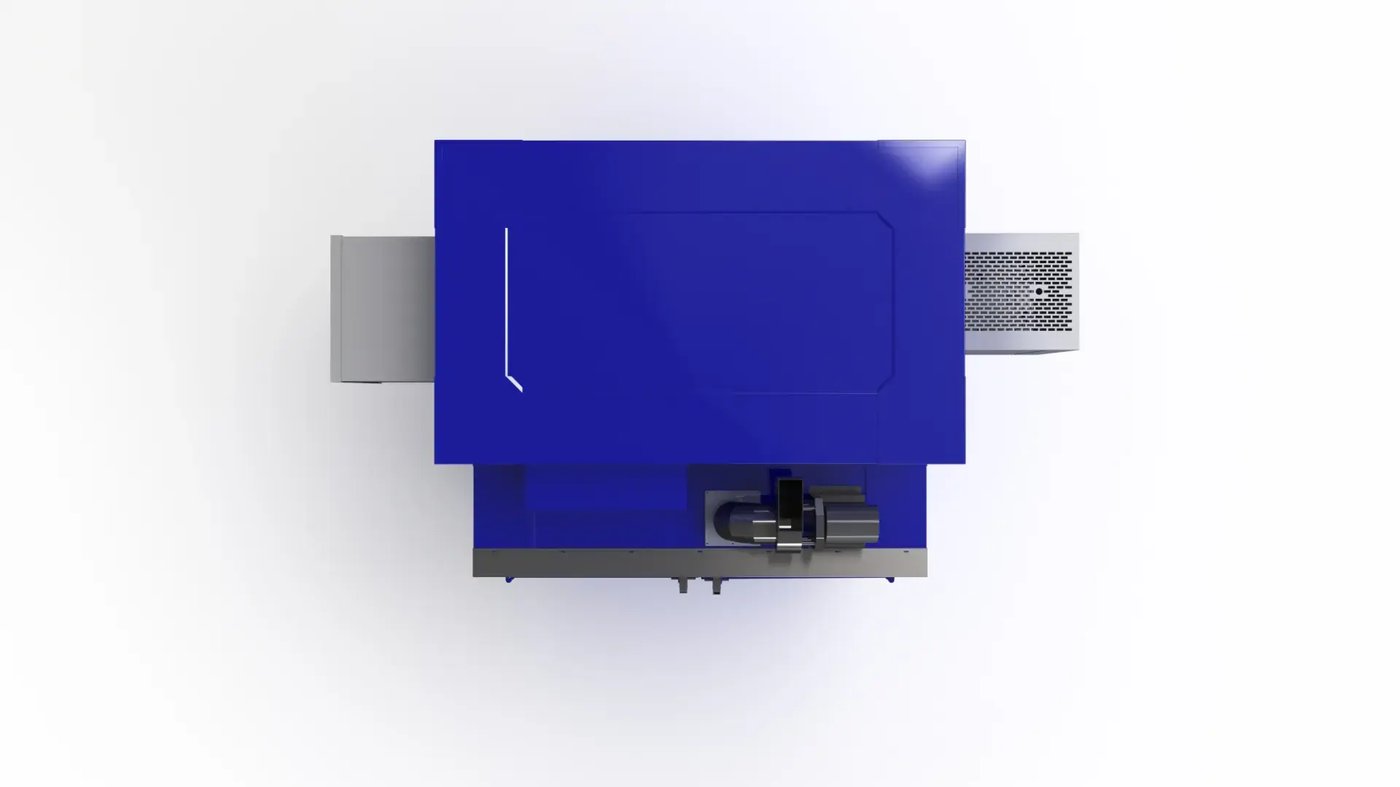
To satisfy those requirements, Precision Quincy configured the project as a 74-800 electric Class A truck oven with horizontal airflow, two-stage electric heat, powered exhaust, integrated floor guides, and interlocked controls.
OVERALL CONCEPT
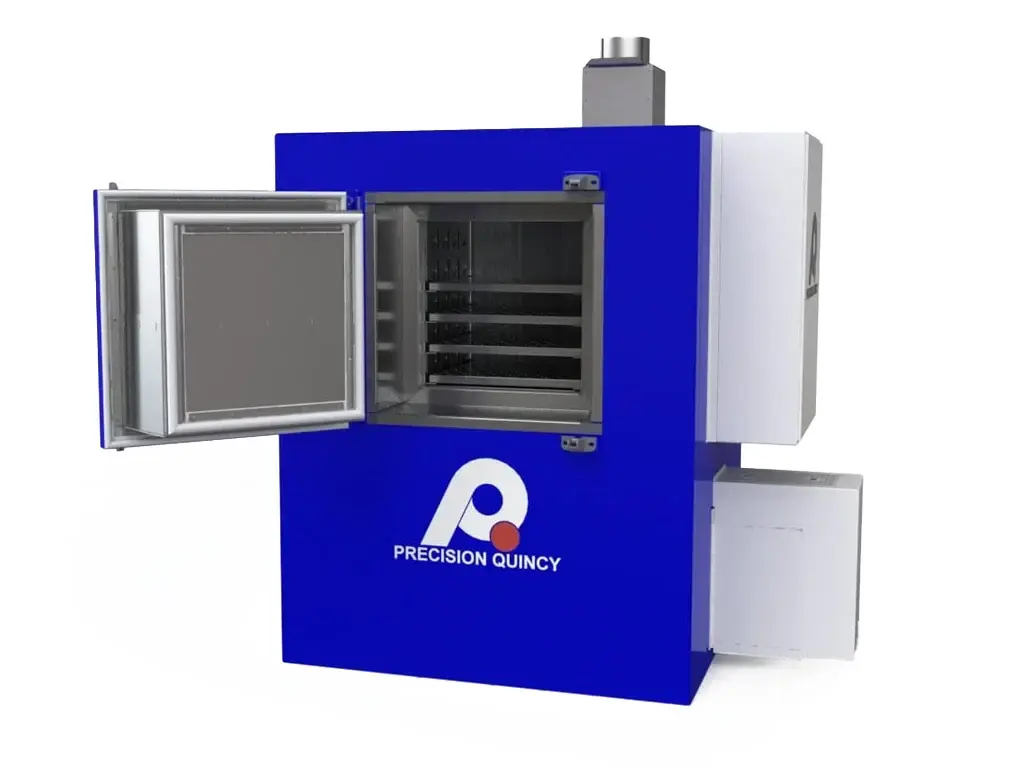
- One electric Class A truck oven
- Batch-processing format for blade-curing cycles
- Front-loading double-door chamber with guided floor loading arrangement
HEATING ARCHITECTURE
- Heat source: electric resistance heat
- Total installed heat: 54 kW
- Heating split into two 27 kW heater banks
- Heater banks built from eighteen 3 kW elements total
- Heater power controlled through solid-state relays with backup contactors
AIRFLOW ARCHITECTURE
- Airflow pattern: full horizontal airflow
- Recirculation system based on a 13.5 in x 5 in fan assembly delivering 2,100 CFM at 2 in. W.c.
- Airflow package sized to support consistent crossflow through the blade-processing work zone
EXHAUST / VENTILATION ARCHITECTURE
- Class A exhaust based on a PQ1 exhauster delivering 550 CFM at 1 in. W.c.
- Fresh-air damper integrated into the oven body
- Airflow switches and purge timing interlocked with the heating system
CHAMBER / SHELL ARCHITECTURE
- Internal work chamber: 48 in W x 48 in D x 60 in H
- 6-inch insulated wall construction
- Wall insulation: 6 inches of 6 lb mineral wool
- Heat-chamber walls: 5 inches of 6 lb mineral wool plus 1 inch of 8 lb Superwool
- Interior material: unpainted aluminized steel
- Exterior finish: Traffic Grey (RAL 7042)
- Control enclosure finish: ANSI 61 gray
- Floor design includes integrated guide tracks for truck-style loading
DOOR / LOADING ARCHITECTURE
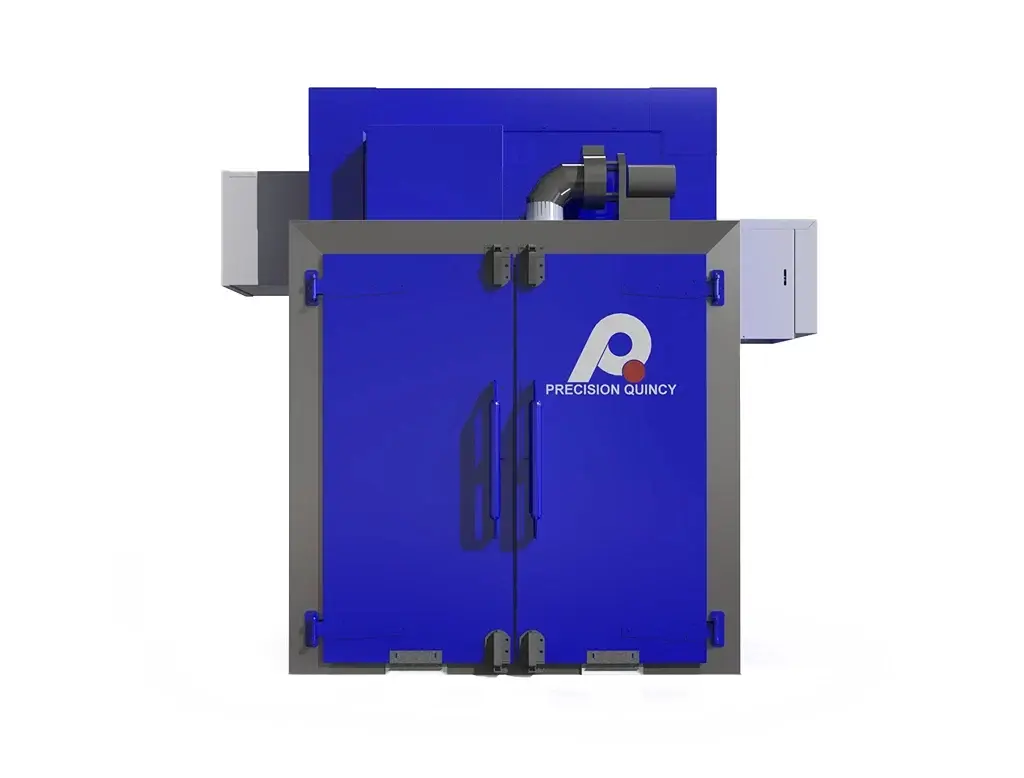
- Two swing doors
- Insulated floor with guided loading path
- Chamber geometry and loading format support stable batch positioning while maintaining airflow access around the load
CONTROLS ARCHITECTURE
- Watlow F4T ramp/soak controller for primary temperature control
- Gefran 650L excess-temperature controller
- Type J thermocouples
- NEMA 1 UL508A open industrial control panel
- Dedicated operator controls for exhaust fan, recirculation fan, and each heat bank
- Panel indication for purge complete, fan on, and heat bank on
- Panel layout includes enclosure cooling and USB access
SAFETY ARCHITECTURE
- Applicable standards basis: NFPA 79, NFPA 86, UL508A
- Safety logic includes:
- Exhaust airflow proving
- Recirculation airflow proving
- Timed purge before heat enable
- Excess-temperature shutdown
- Automatic heat shutdown when required safe operating conditions are not met
| OVEN CONFIGURATION | |
|---|---|
| Model | 74-800 |
| Type | Electric Class A truck oven |
| Quantity | 1 oven |
| Application | Blade curing |
| Airflow Pattern | Full horizontal airflow |
| Work Chamber | 48 in W x 48 in D x 60 in H |
| Door Configuration | 2 swing doors |
| THERMAL SYSTEM | |
|---|---|
| Operating Temperature | 600°F - 650°F |
| Maximum Temperature | 800°F |
| Uniformity | ±10°F |
| Heat Source | Electric resistance heat |
| Installed Heat | 54 kW total |
| Heater Banks | 2 x 27 kW |
| Element Basis | 18 total elements, 3 kW each |
| Maximum VOC Load | 0.32 gal/batch o-xylene |
| Design Elevation | <1,000 ft |
| RECIRCULATION / AIRFLOW SYSTEM | |
|---|---|
| Airflow Pattern | Full horizontal |
| Recirculation Fan Performance | 2,100 CFM at 2 in. W.c. |
| Recirculation Fan Motor | 2 HP |
| Estimated Average Chamber Air Velocity | ~105 FPM |
| EXHAUST / VENTILATION SYSTEM | |
|---|---|
| Exhaust Fan | PQ1 exhauster |
| Exhaust Airflow | 550 CFM |
| Exhaust Static Pressure | 1 in. W.c. |
| Exhaust Fan Motor | 0.75 HP |
| Minimum Purge Time | 3 minutes |
| Oven Classification | Class A |
| CONSTRUCTION | |
|---|---|
| Wall Thickness | 6 in |
| Wall Insulation | 6 in of 6 lb mineral wool |
| Heat Chamber Wall Insulation | 5 in of 6 lb mineral wool + 1 in of 8 lb Superwool |
| Interior Material | Unpainted aluminized steel |
| Exterior Finish | Traffic Grey (RAL 7042) |
| Control Enclosure Finish | ANSI 61 gray |
| CONTROLS & SAFETY | |
|---|---|
| Main Temperature Controller | Watlow F4T ramp/soak |
| Excess Temperature Controller | Gefran 650L |
| Thermocouple Type | Type J |
| Control Enclosure | NEMA 1 |
| Enclosure Listing Basis | UL508A Open Industrial Control Panel |
| Enclosure Size | 42 in x 36 in x 12 in |
| Full Load Amps | 73.5 A |
| SCCR | 5,000 amps |
| Airflow Proving | Exhaust and recirculation airflow switches |
| Heat Control | SSRs with backup contactors |
| Cooldown Protection | Fans remain on until below 250°F |
| EQUIPMENT DIMENSIONS | |
|---|---|
| Overall Width | 88.80 in |
| Overall Depth | 65.59 in |
| Overall Height | 95.47 in |
| Oven Body Width | 74.25 in |
| Oven Body Depth | 61.64 in |
| Work Area Width | 48.00 in |
| Work Area Depth | 48.00 in |
| Work Area Height | 60.00 in |
| Floor to Top of Control Enclosure | 52.00 in |
| PROCESS SUMMARY | |
|---|---|
| Process Type | Batch blade curing |
| Market Context | Aeroderivative turbine component processing |
| Thermal Method | Forced-convection electric heating with horizontal airflow |
| Control Method | Ramp/soak cycle control with Class A purge and airflow interlocks |
| Key Performance Basis | Repeatable curing in a 600°F - 650°F operating window with ±10°F uniformity |