

Project Number: 5490
Polyurethane Cure Oven for Automated Polyurethane Forklift Wheel Manufacturing
.webp?width=1400&name=5490%20KOOPS%20(2).webp)
.webp?width=1400&name=5490%20KOOPS%20(3).webp)
.webp?width=1400&name=5490%20KOOPS%20(4).webp)
.webp?width=1400&name=5490%20KOOPS%20(5).webp)
.webp?width=1400&name=5490%20KOOPS%20(6).webp)
.webp?width=1400&name=5490%20KOOPS%20(7).webp)
.webp?width=1400&name=5490%20KOOPS%20(8).webp)
.webp?width=1400&name=5490%20KOOPS%20(9).webp)
Overview
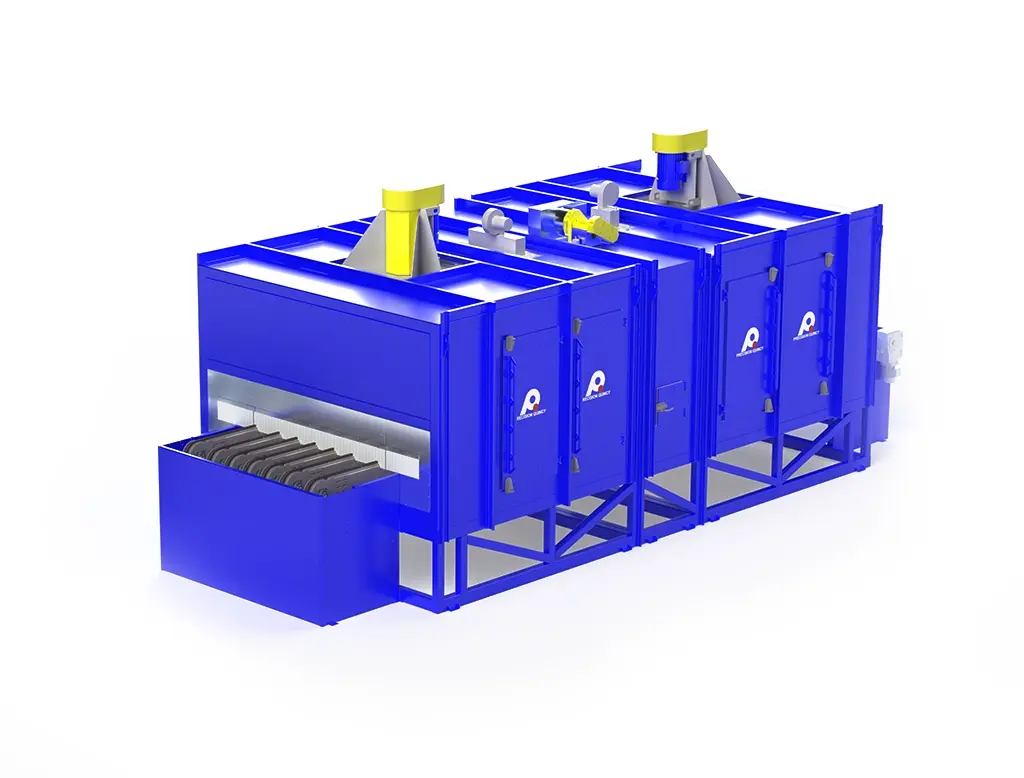
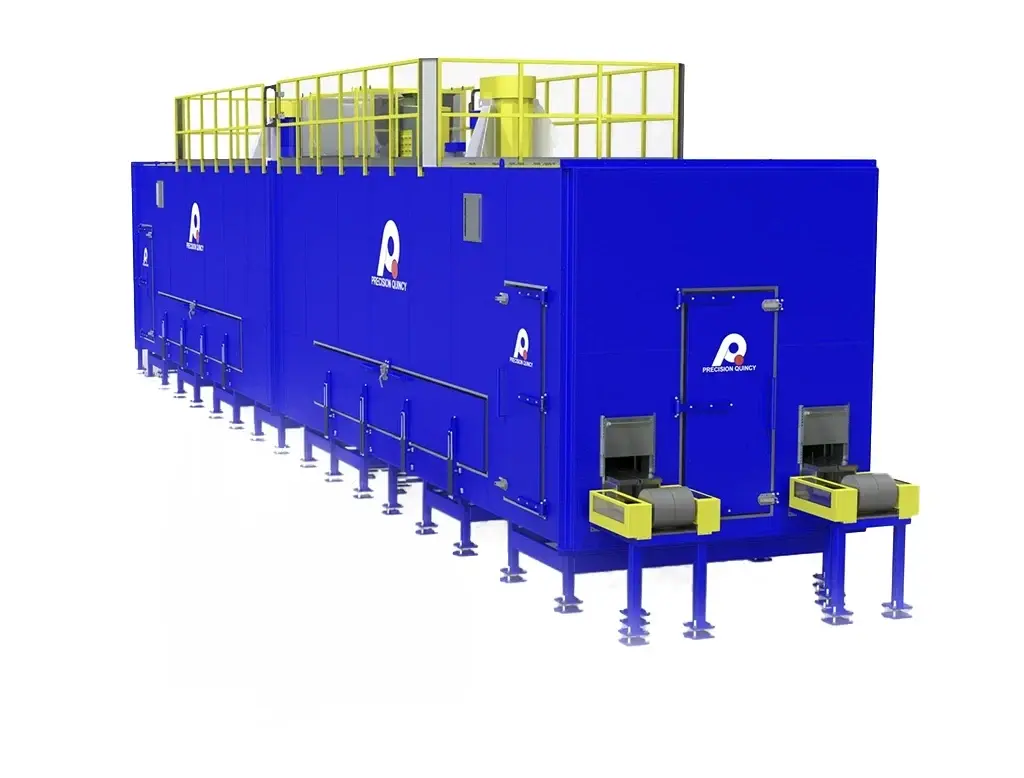
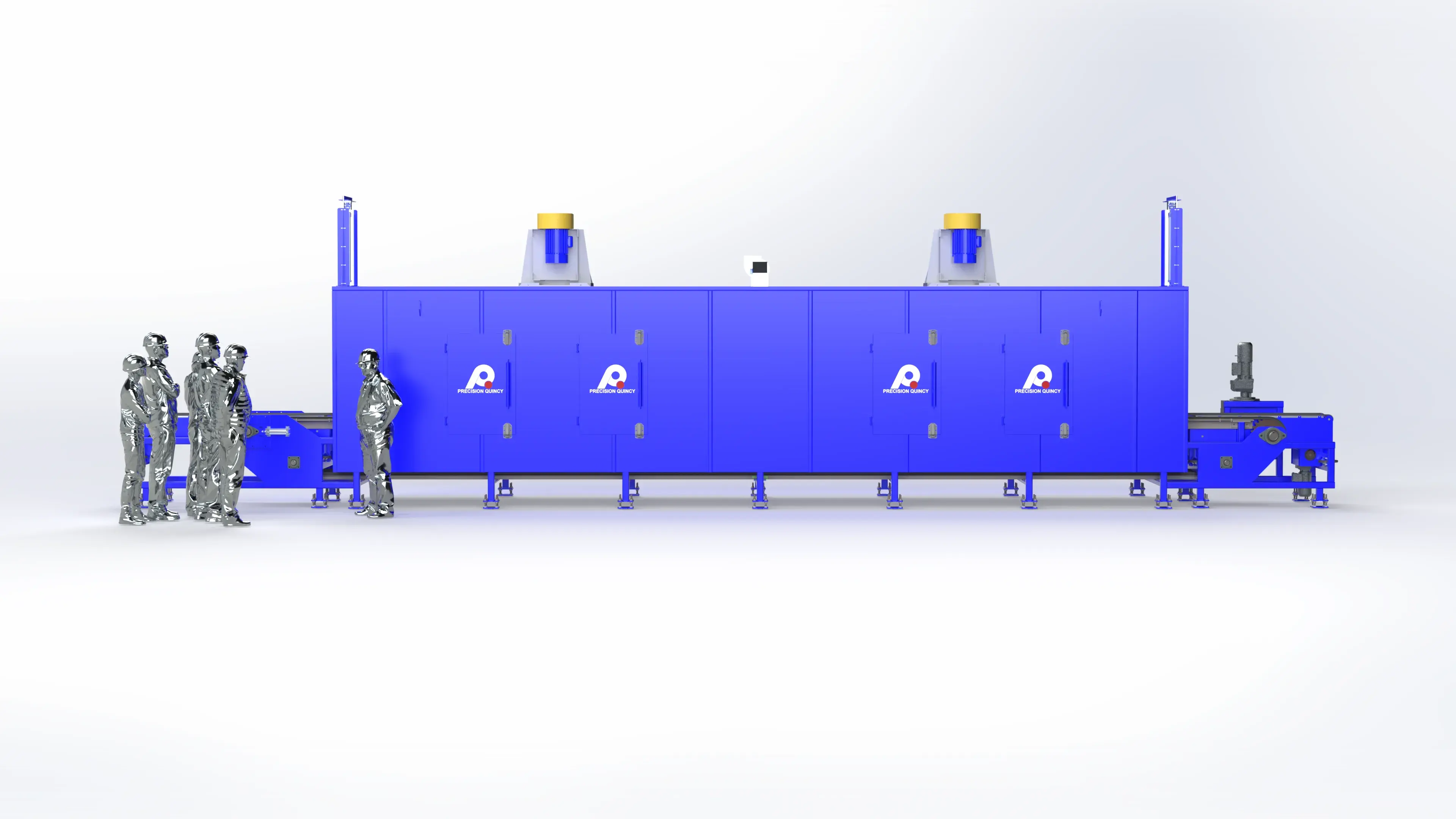
This project was developed as the primary polyurethane cure oven within a multi-stage forklift wheel production system. After upstream preparation and flash-off steps were completed, this machine advances molded wheel assemblies through a controlled cure cycle using indexed motion, forced convection, and electric resistance heat.
The machine was designed around a heavier-duty production role than the earlier stages in the line. It had to move large loaded assemblies through a repeatable eight-station process path, maintain timing with adjacent handling systems, and provide the thermal stability needed to advance polyurethane state before downstream reheat and post-cure stages.
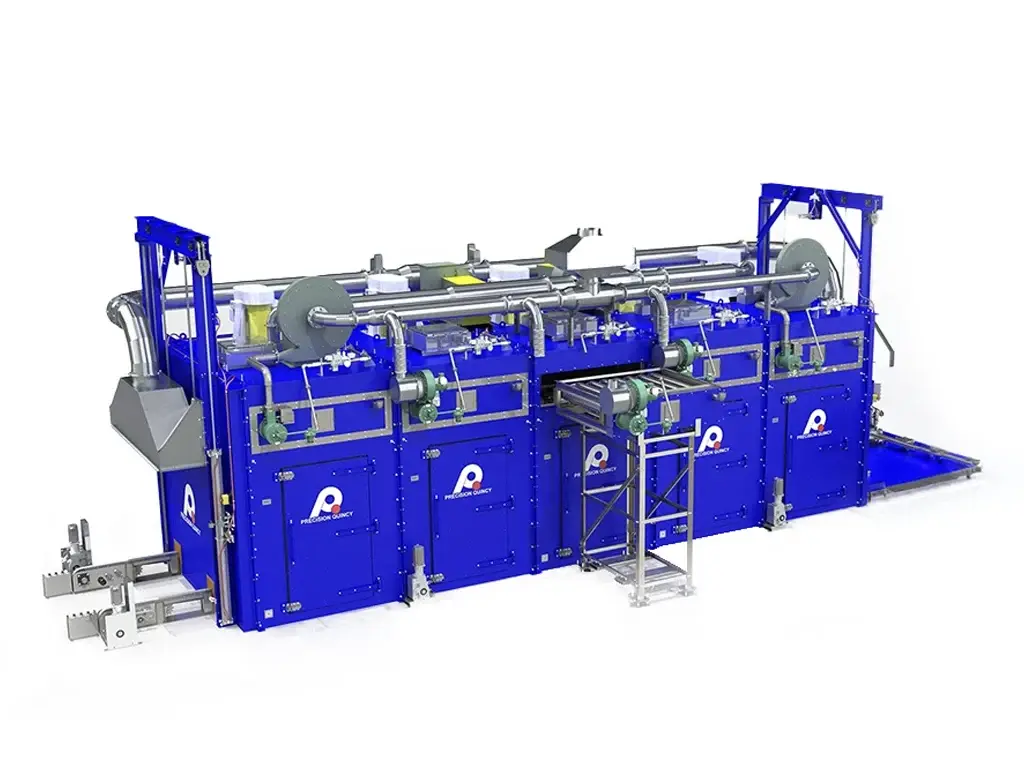
Rather than treating cure as a generic heat-and-hold task, the equipment was engineered specifically around this point in the wheel-manufacturing sequence. The oven combines heavy-load chain conveying, transfer interfaces, controlled recirculation airflow, and Class B thermal architecture in one coordinated process module. The result is a dedicated primary cure stage built around thermal repeatability, high load capacity, indexed motion, and automation-ready handling.
The process requirement was to provide the main polyurethane cure stage for molded wheel assemblies moving through an automated production line. The machine had to advance the product far enough thermally to support the next manufacturing stage while preserving line timing, load sequencing, and automation compatibility.
APPLICATION REQUIREMENT
- The equipment serves as the primary polyurethane cure stage for molded wheel assemblies in an automated forklift wheel manufacturing line.
- The machine advances product thermally to a state suitable for the downstream reheat and post-cure stages that follow in the manufacturing sequence.
- The cure stage operates as part of a coordinated manufacturing platform rather than a stand-alone process island.
PRODUCT LOAD / HANDLING REQUIREMENT
- Because this stage handles larger and heavier loaded assemblies, the oven supports substantial product mass together with repeatable indexed movement.
- The equipment required a robust conveyor path, stable product positioning, and dependable transfer behavior between the cure oven and adjacent production modules.
LINE INTEGRATION REQUIREMENT
- The machine accepts product from upstream automation, holds predictable station-to-station timing, and discharges assemblies in a controlled state for the following reheat stage.
- The control architecture is compatible with the Allen-Bradley platform used across the broader production line.
- Transfer conveyors bridge the cure oven to adjacent production operations so the module functions as a dedicated stage within the overall line rather than a disconnected thermal chamber.
SAFETY / CLASSIFICATION REQUIREMENT
- The oven was classified as NFPA 86 Class B, reflecting that this stage is part of the cure sequence rather than a solvent-bearing flash-off process.
UTILITY REQUIREMENT
- Required electrical service: 480V / 3PH / 60Hz.
The thermal process requirements were established from the need to advance polyurethane cure state in molded forklift wheel assemblies at the primary cure stage of an automated manufacturing line.
TEMPERATURE CAPABILITY
- Operating temperature: 265°F to 275°F.
- Maximum design temperature: 300°F.
PROCESS BASIS
- The thermal process basis is the primary polyurethane cure of molded wheel assemblies, positioned ahead of downstream reheat and post-cure operations.
- The machine delivers a stable forced-convection environment sufficient to advance polyurethane state within the available dwell time at the specified index interval.
HEAT INPUT REQUIREMENT
- Heat source: electric resistance heat.
- Total installed heat input: approximately 108 kW.
AIRFLOW DELIVERY REQUIREMENTS
- Recirculation fans: two New York Blower 248 PLR plug fans.
- Recirculation airflow: approximately 9,000 CFM each, 18,000 CFM total.
- The recirculation airflow package supports the forced-convection environment required for the primary cure function.
EXHAUST / VENTILATION BASIS
- Exhaust fan: PQ1 exhauster rated at approximately 550 CFM; 0.75 HP motor.
- Oven classification: NFPA 86 Class B.
DWELL / CYCLE BASIS
- Work path: eight stations inside the heated process envelope.
- Index rate: 46 in. every 178.1 seconds at approximately 10 ft/min.
- Dwell in heat: approximately 26.8 minutes.
To deliver the process requirements for the primary polyurethane cure stage, the following equipment concept and architecture was developed.
OVERALL CONCEPT
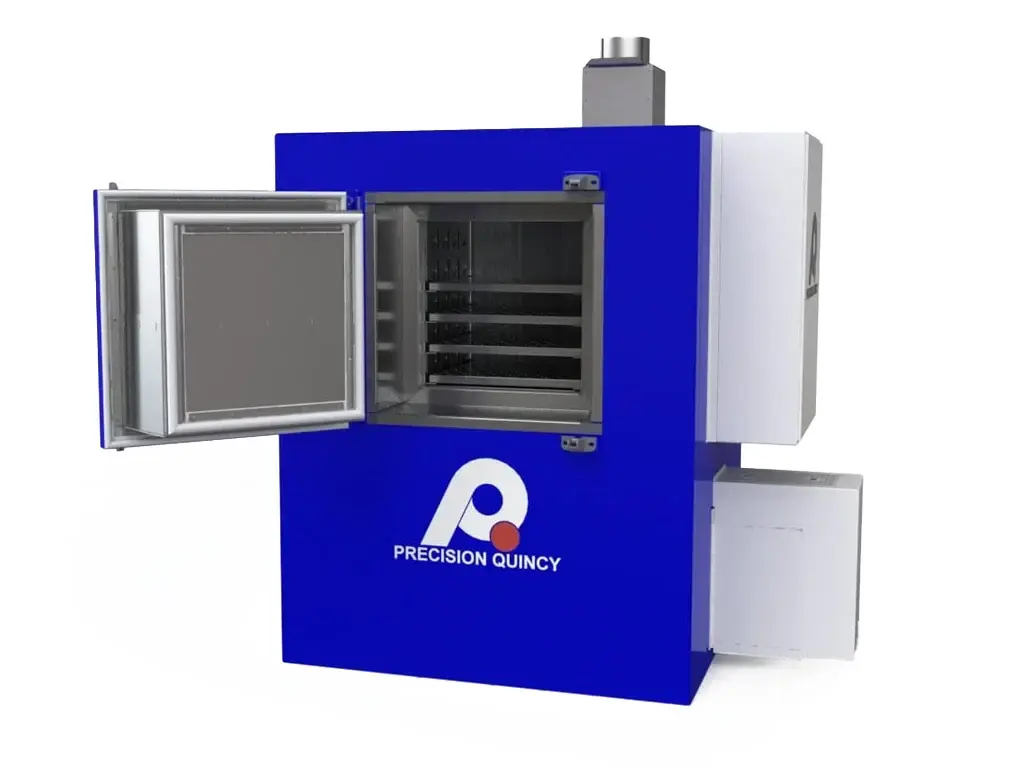
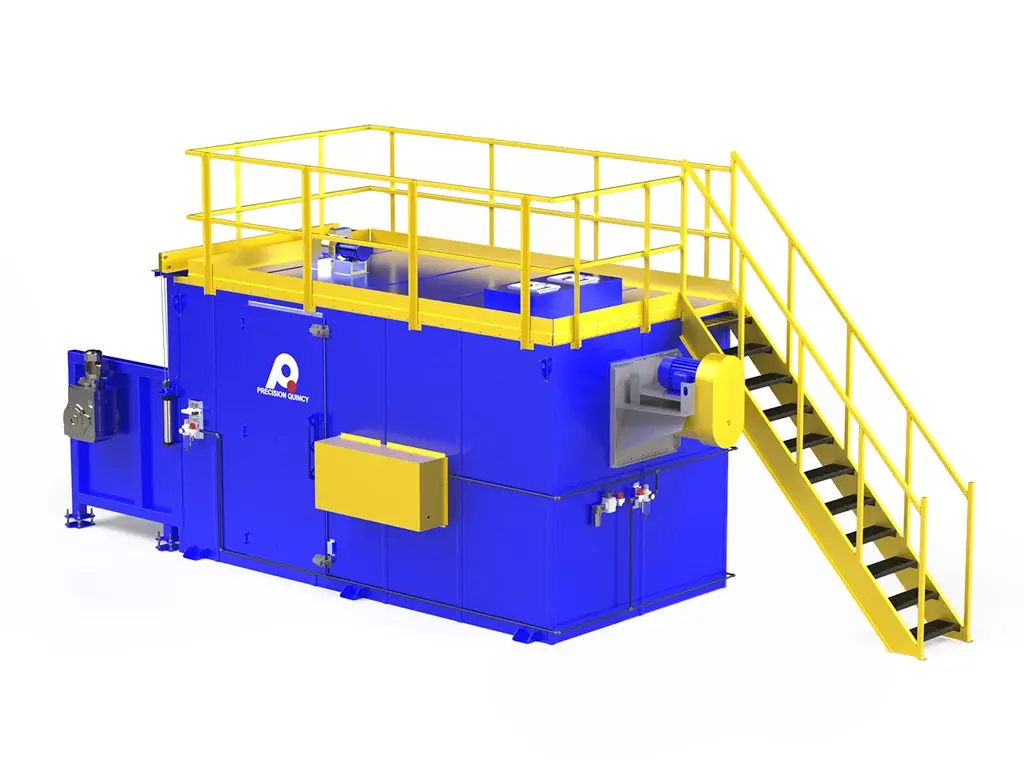
- One electric-heated indexed conveyor cure oven serving as the primary polyurethane cure module in an automated forklift wheel manufacturing line.
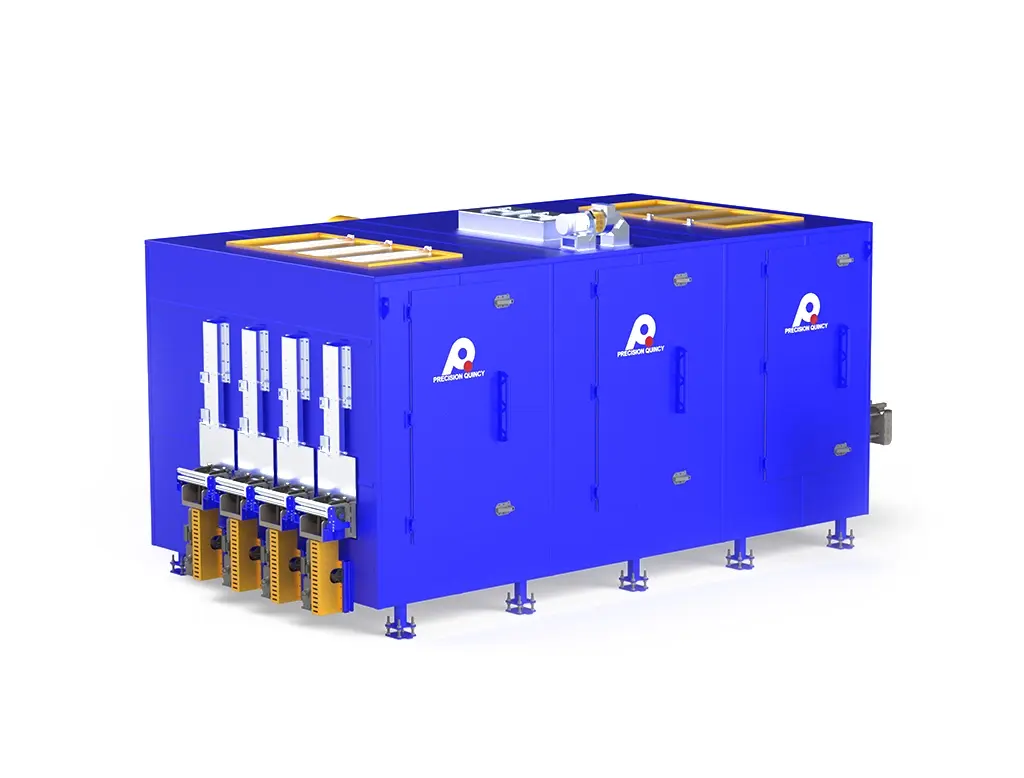
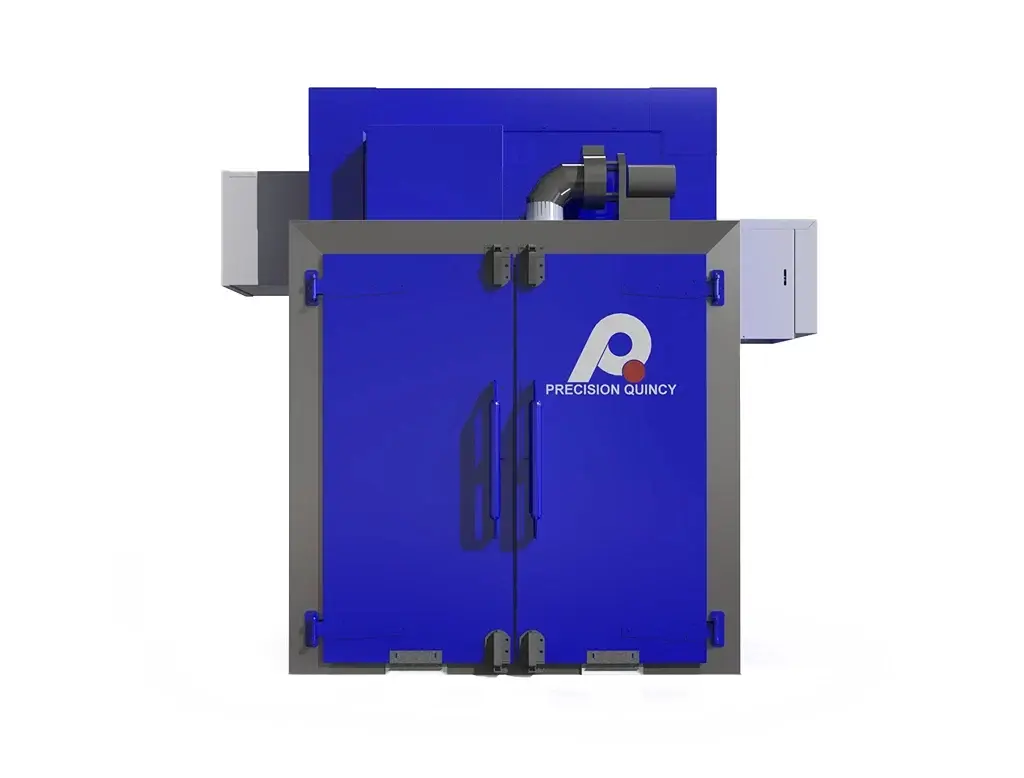
- The machine is built on structural steel reinforced pan-style construction, supporting the oven's conveyor openings, transfer interfaces, repeated indexed cycling, and production-line service requirements.
HEATING ARCHITECTURE
- Heat source: electric resistance heating.
- Total installed heat input: approximately 108 kW.
AIRFLOW / RECIRCULATION ARCHITECTURE
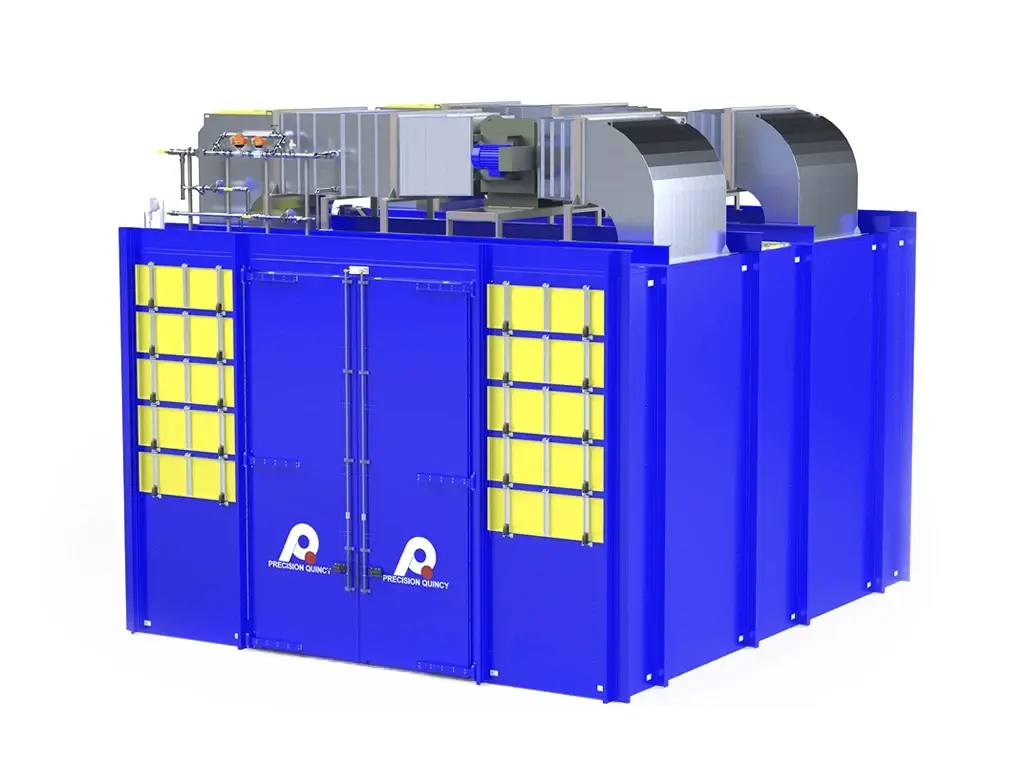
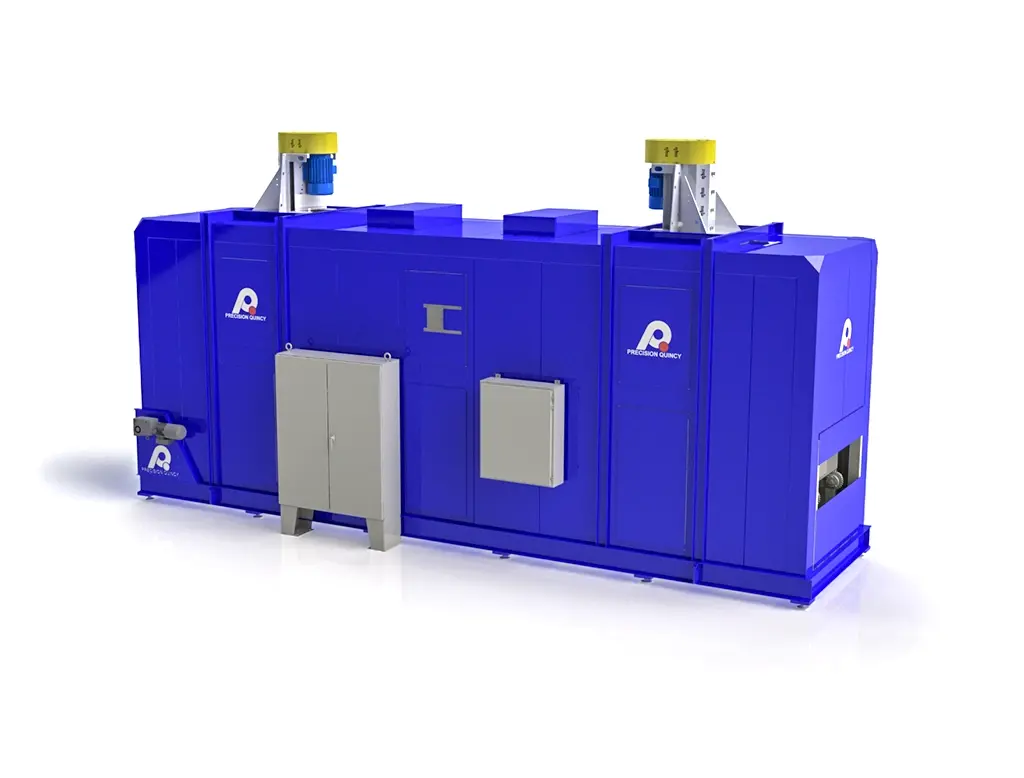
- Recirculation fans: two New York Blower 248 PLR plug fans delivering approximately 9,000 CFM each, 18,000 CFM total.
- Exhaust: PQ1 exhauster at approximately 550 CFM; 0.75 HP motor.
CONVEYOR / HANDLING ARCHITECTURE
- Main conveyor: three lines of C2082H K-1 steel roller chain sized for substantial assembly loads.
- Main conveyor capacity: approximately 36,750 lb maximum product load.
- Indexing motion: 46 in. every 178.1 seconds at approximately 10 ft/min, coordinated with the broader automation sequence.
- Transfer conveyors: two RS60-2 steel roller chain transfer conveyors bridging the cure oven to adjacent production operations.
SHELL / CONSTRUCTION ARCHITECTURE
- Shell construction: structural steel reinforced pan-style oven construction.
- Overall approximate dimensions: 536.43 in. deep × 107.73 in. wide × 165.13 in. high.
- The shell approach supports conveyor openings, transfer interfaces, repeated indexed cycling, and production-line service requirements while maintaining thermal containment and mechanical rigidity.
CONTROLS ARCHITECTURE
- Control platform: Allen-Bradley line-integrated controls architecture consistent with the broader production line.
- Control enclosure: remote-mounted NEMA 12 enclosure.
- The controls package includes distributed I/O, machine interlocks, operator interface capability, and coordinated communication with adjacent equipment.
- Line-integrated controls are essential in this cure stage where product position, timing, and handoff to the next machine are as important as chamber temperature.
| OVEN CONFIGURATION | |
|---|---|
| Type | Electric-heated indexed conveyor cure oven |
| Application | Primary polyurethane cure stage for molded forklift wheel assemblies |
| Safety Class | NFPA 86 Class B |
| Work Path | Eight stations inside work area |
| Shell Construction | Structural steel reinforced pan-style oven construction |
| Approx. Overall Size | 536.43 in. deep × 107.73 in. wide × 165.13 in. high |
| THERMAL SYSTEM | |
|---|---|
| Operating Temperature | 265°F–275°F |
| Maximum Temperature | 300°F |
| Heat Source | Electric resistance heat |
| Heat Input | 108 kW |
| Recirculation Fans | Two NYB 248 PLR plug fans |
| Recirculation Airflow | 9,000 CFM each; 18,000 CFM total |
| Exhaust Fan | PQ1 exhauster |
| Exhaust Airflow | Approx. 550 CFM |
| Exhaust Motor | 0.75 HP |
| Dwell in Heat | Approx. 26.8 minutes |
| CONVEYOR / HANDLING SYSTEM | |
|---|---|
| Main Conveyor Type | Three lines of C2082H K-1 steel roller chain |
| Main Conveyor Capacity | 36,750 lb max product load |
| Index Rate | 46 in. every 178.1 sec at approx. 10 ft/min |
| Transfer Conveyors | Two RS60-2 steel roller chain transfer conveyors |
| Process Style | Indexed heavy-load cure path integrated into automated production line |
| CONTROLS & ELECTRICAL | |
|---|---|
| Electrical Service | 480V / 3PH / 60Hz |
| Control Cabinet | Remote-mounted NEMA 12 enclosure |
| Control Architecture | Allen-Bradley line-integrated controls platform with distributed I/O |
| Safety Features | Interlocks, machine protection, and Class B thermal safety architecture |
| PROCESS SUMMARY | |
|---|---|
| Product | Molded polyurethane forklift wheel assemblies |
| Market / Application | Automated forklift wheel manufacturing |
| Process Role | Primary polyurethane cure stage ahead of reheat and post-cure operations |
| Integration Role | Heavy-load indexed module coordinated with adjacent transfer and automation systems |
| Key Verification Concept | Repeatable thermal dwell, indexed motion timing, load handling, and line-level handoff control |