High-Throughput Airbag Cap Foil-Sealing Thermal Processing System (900 PPH, ±10℉ Uniformity)
Key Takeaways
- Engineered a three-zone electric conveyor oven (two heat zones + integrated cooling) for high-throughput automotive safety component foil-sealing
- Delivered production throughput of 900 parts/hour while targeting ±10°F temperature uniformity
- Executed a staged thermal profile: 410°F (5.6 min) → 385°F (11.2 min) → 55°F cooling (8.2 min) in one pass
- Maintained timing and spacing with chain-on-edge conveyance and helical bevel gearbox drive (4” index/4-second cycle)
- Designed for real-world operation with NFPA 86 design standards and Mitsubishi iQ-R PLC with dual HMIs
When your process touches automotive safety components, thermal performance has to be precise and reliable. For us, that starts with a simple assumption: the oven isn’t just equipment. It’s a quality gate. The system has to run continuously, hold tight tolerances, and keep pace with production. If the oven falls behind or drifts out of profile, the entire line feels it. And any variation downstream is expensive at best and unacceptable at worst.
On this project, a global automotive safety systems manufacturer came to Precision Quincy under a familiar kind of manufacturing pressure: rising demand and an industry-wide push to simplify processes and reduce cost. Airbag inflator-related components, in particular, were under scrutiny.
We’ve seen different approaches to airbag inflator cap foil-sealing tested over the years. When manufacturers try to reduce steps, the temptation is to remove thermal energy where possible and rely on pressure alone. In a safety-critical automotive application, that gets sensitive quickly because if performance isn’t consistent, variability leads to risk. Risk, in turn, can lead to compromised safety and high-profile recalls, which is exactly what happened in the automotive industry several years ago.
Our customer made a deliberate choice to maintain a controlled thermal bonding process, hermetically sealing foil membranes to airbag inflator caps. The challenge wasn’t proving the process, but rather scaling it fast. The legacy ovens in their other facility with batch-style flow weren’t built to support high throughput without sacrificing thermal repeatability.
Scaling a proven process for a global rollout
This project wasn’t only about adding capacity at a single site. Our customer was standardizing this proven thermal bonding process and expanding it for global production, including in another one of the customer’s greenfield facilities.
From an engineering standpoint, the project created two constraints for our team:
-
Footprint: We had to design for a significantly smaller oven footprint that matched available floor space
-
Global installation and serviceability: The system needed to be uniformly installed, commissioned, and maintained across facilities with different infrastructure and support capabilities
The engineering approach
The critical insight was treating the footprint constraint as a layout problem to solve, not a performance trade-off to accept.
Our approach was straightforward:
- Start with the workpiece and define what the process needs for heat transfer
- Lock in dwell requirements and the process window
- Build the mechanical design, motion system, controls, and safety architecture around those needs rather than forcing the process to fit the customer’s legacy system
The goal wasn’t simply to “heat the part.” We needed a repeatable, production-ready system where zones, airflow, indexing, and controls work together within a narrowly defined process window. At 900 parts/hour, there’s not “extra time” to fix inconsistencies.
Project at a glance
-
Application: Hermetic foil-sealing of airbag inflator caps for automotive safety restraint systems
-
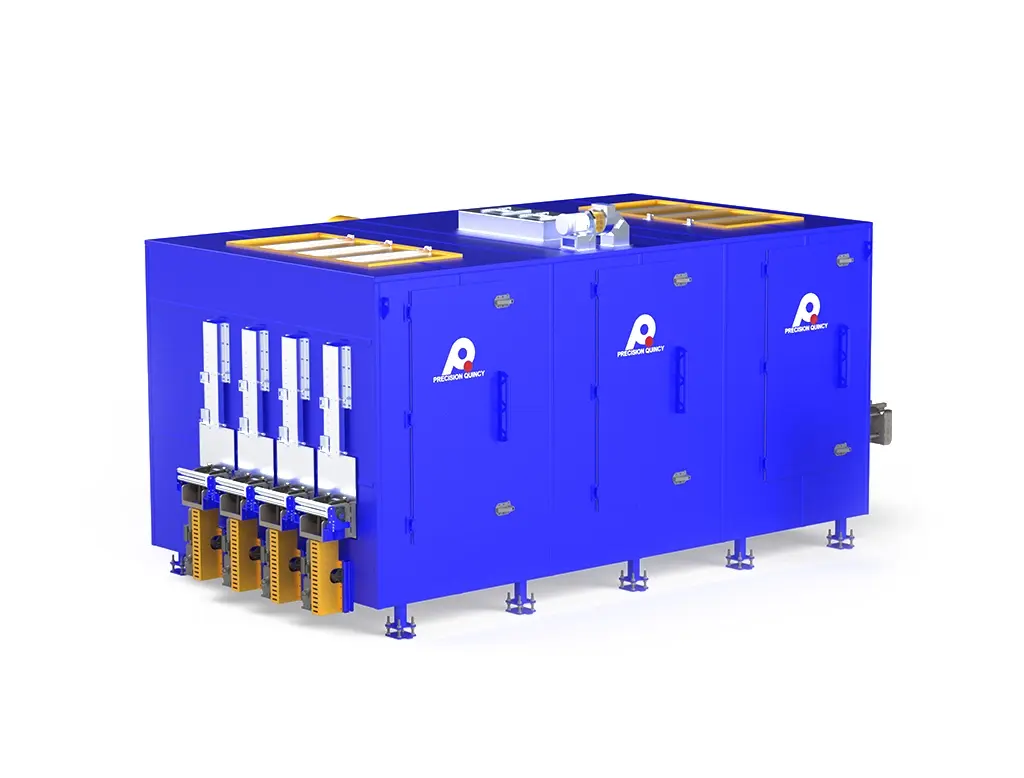
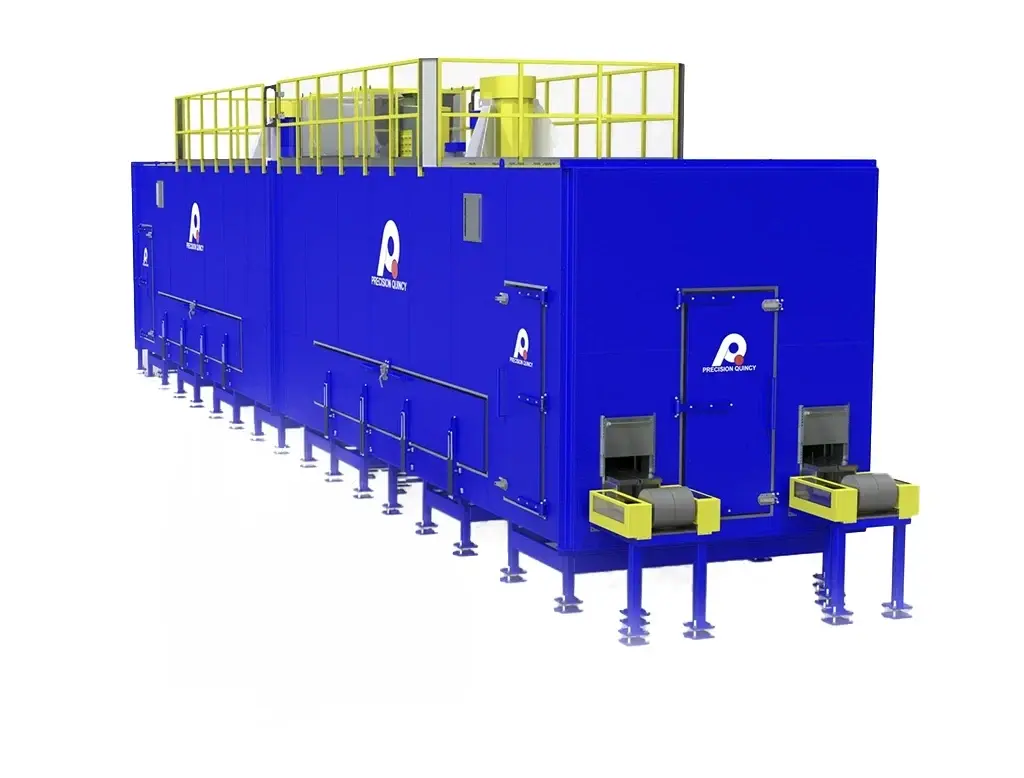
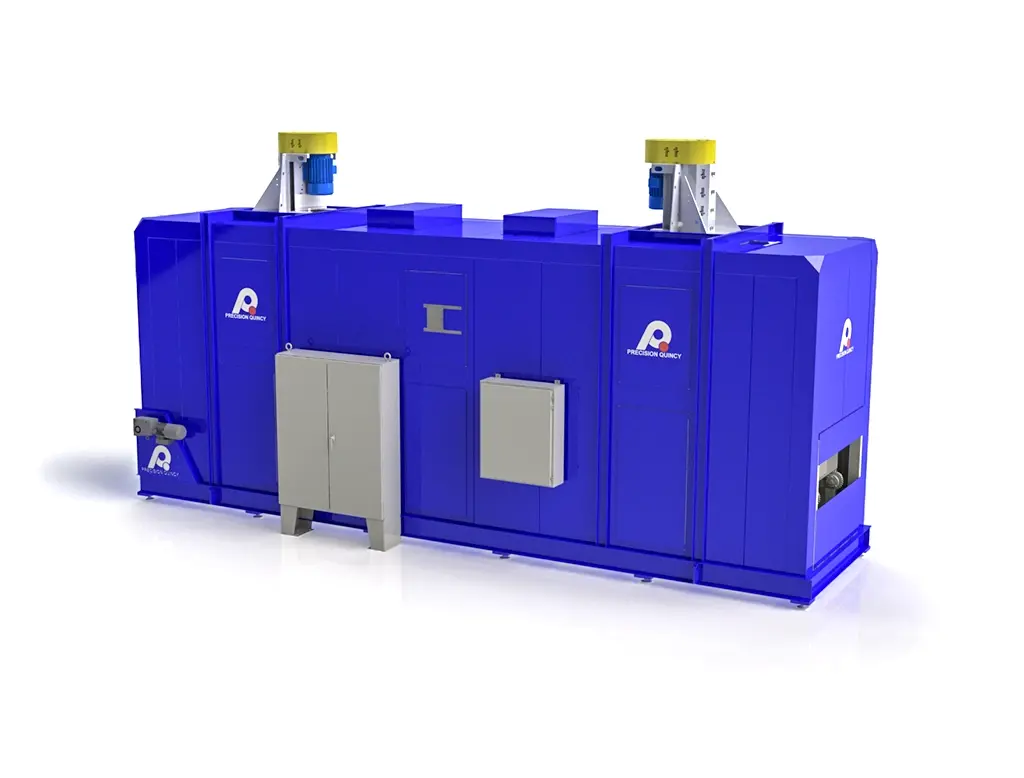
System: Three-zone electric conveyor oven with integrated cooling and helical bevel gearbox indexing drive
-
Throughput: 900 parts/hour in single-piece flow
-
Uniformity: ±10℉ to support consistent foil-sealing results
-
Configuration: 3 zones (2 heat, 1 cool)
-
Thermal profile: 410℉ → 385℉ → 55℉ (continuous pass)
-
Compliance: NFPA 86 Class B; UL 508A-labeled control panel
-
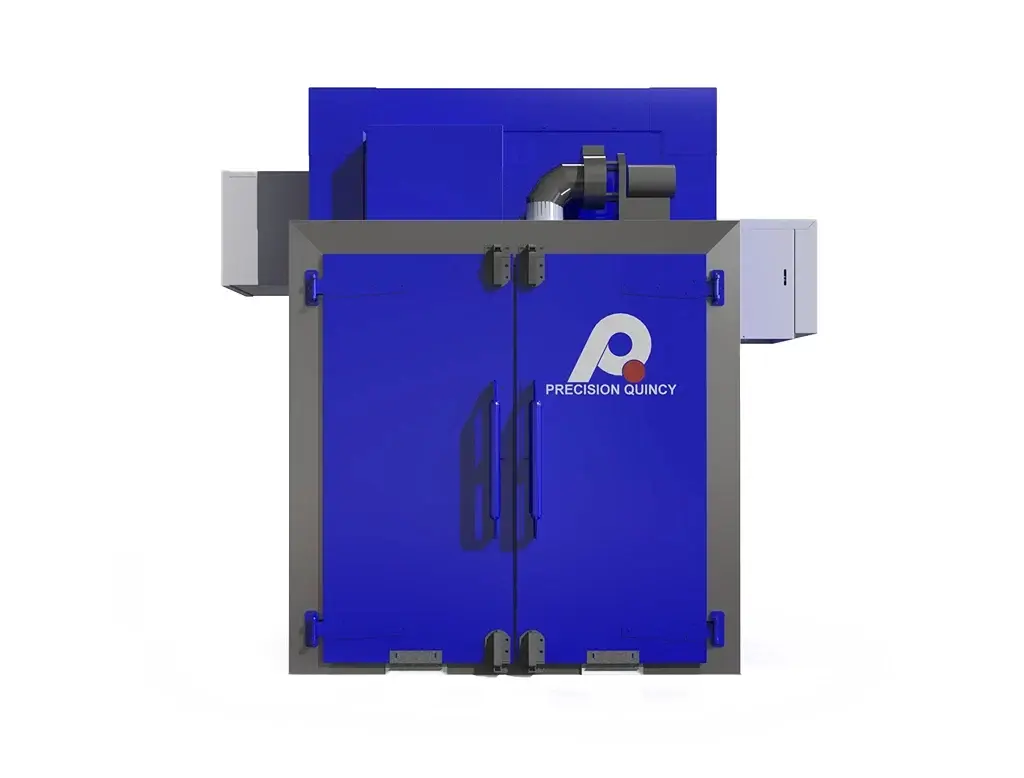
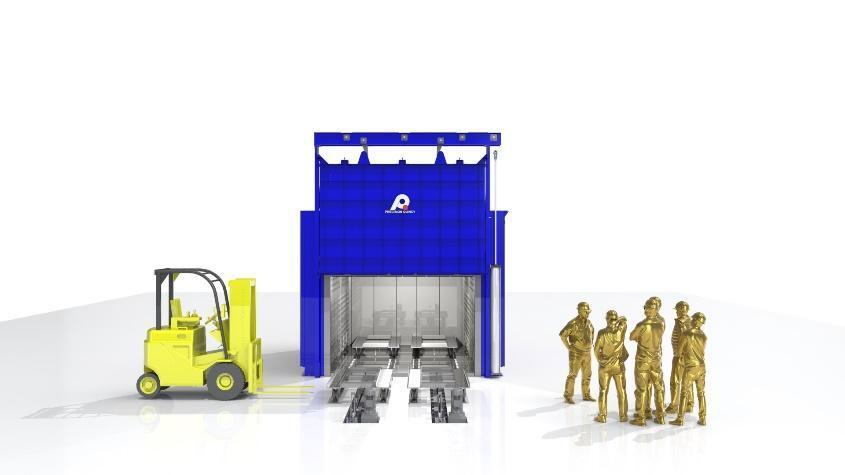
Overall dimensions: 150.6”H x 190”W x 156”D (operating); 123.5”D (shipping)
-
Weight: 19,000 pounds
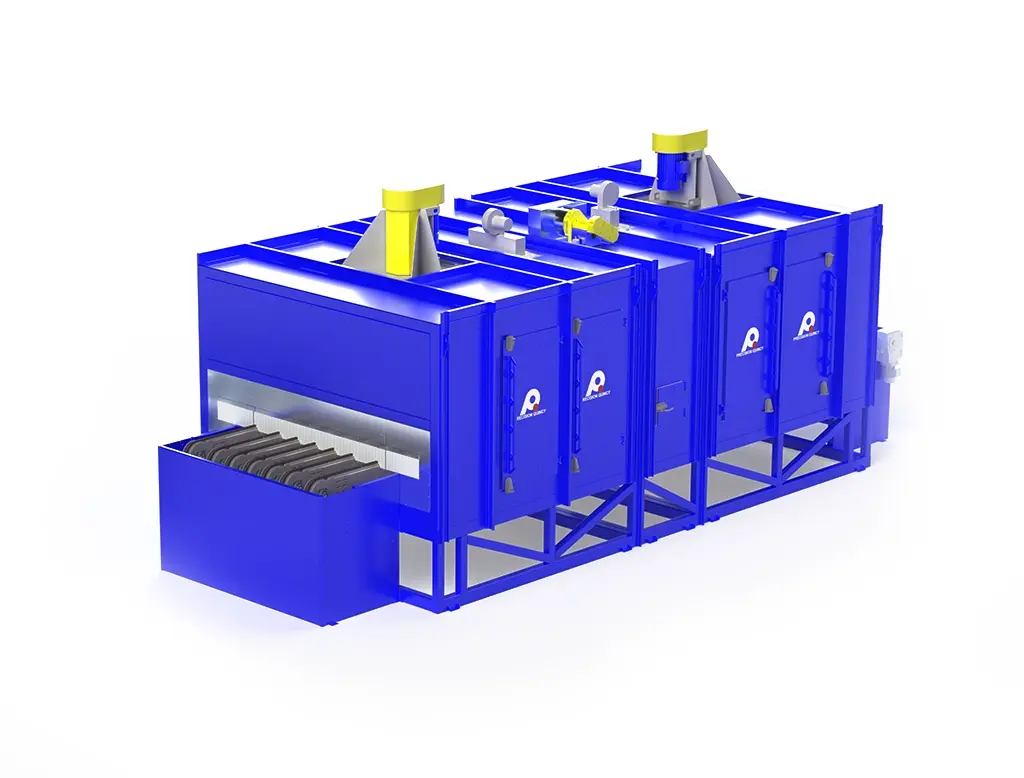
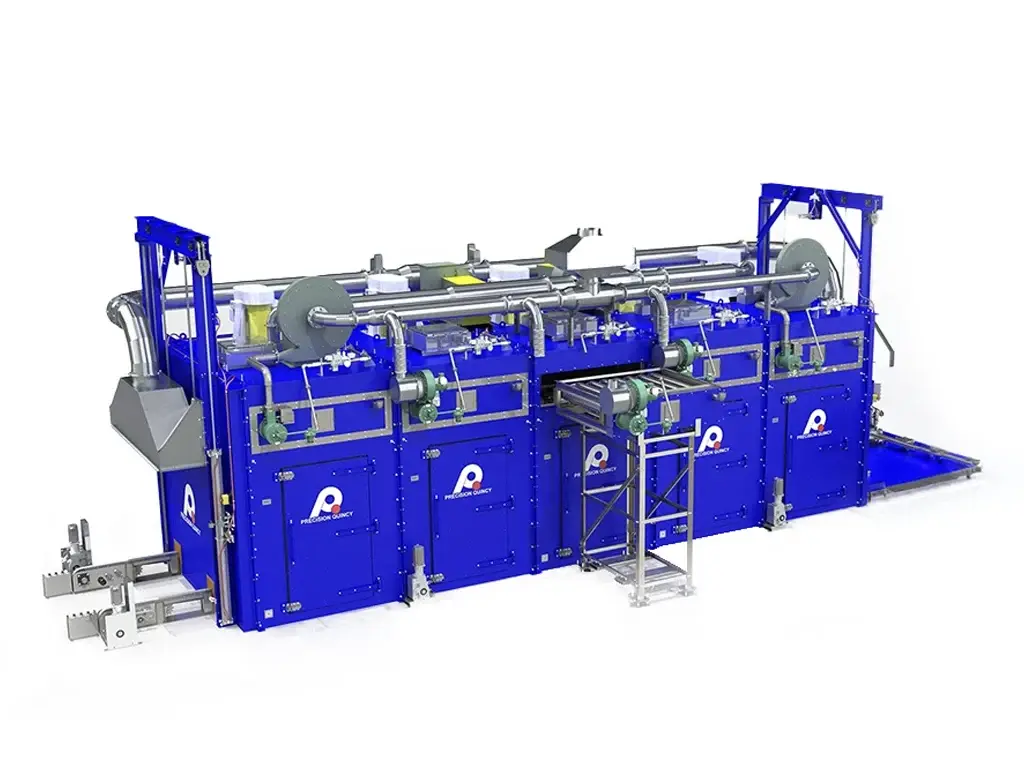
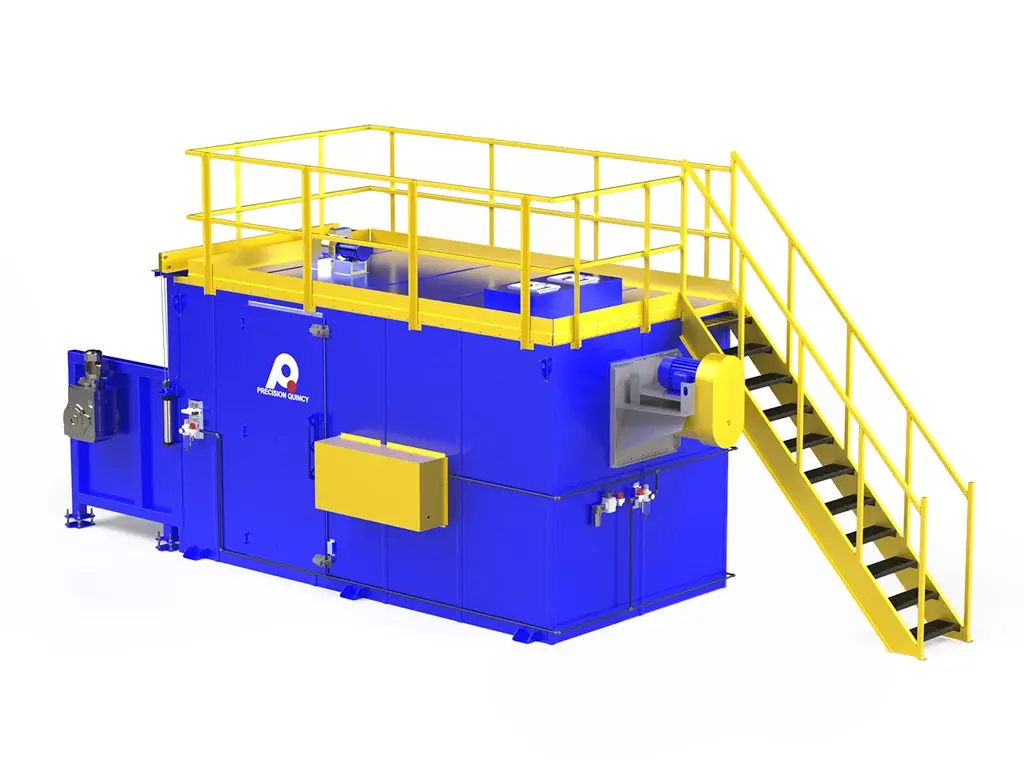
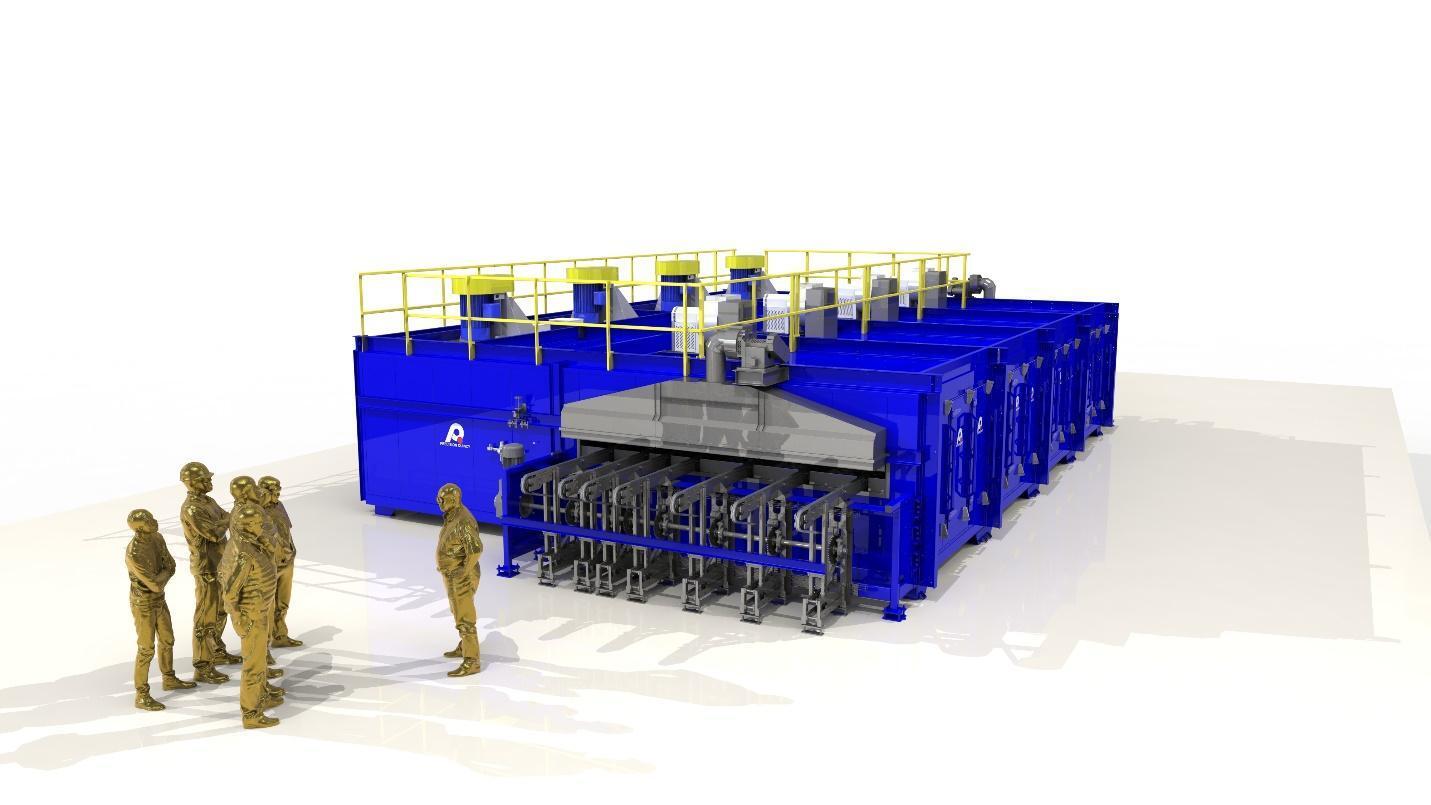
To meet the requirements, our team engineered a three-zone electric conveyor oven with two heated zones and an integrated cooling section. One of the most important design decisions we made was using vertical downflow airflow across the process to stabilize heat transfer from part to part.
Zone design and thermal profile
Ultimately, thermal performance can look perfect on paper and still fall short in production if conveyance timing and safety systems aren’t engineered with the same rigor as heaters and airflow. We treated the solution as a managed oven process, not a collection of components.
Heated Zone 1: Establish the profile at temperature
-
Setpoint: 410°F
-
Dwell: 5.6 minutes
-
Heat input: 72 kW electric with SSR power control
-
Airflow: 7,400 ACFM delivered through ~4,000 FPM nozzles
Zone 1 is where the process starts to become predictable. We designed it for consistent energy input and dependable temperature recovery under load, so the cycle always begins the same way.
Heated Zone 2: Complete the thermal bond with controlled dwell
Two sequential heat zones provide control a single-zone oven can’t. We introduced a second heated stage at a slightly lower setpoint to support the thermal bond without overheating.
-
Setpoint: 385°F
-
Dwell: 11.2 minutes
-
Heat input: 36 kW electric with SSR power control
-
Airflow: dual plug fans generating 14,800 ACFM
Longer dwell at a slightly lower temperature protects the process window while completing the foil seal at full rate.
Cooling Zone: Engineered into the process, not bolted on
Cooling wasn’t an afterthought. It’s an integral part of the process.
-
Target exit temperature: 55°F
-
Cooling time: 8.2 minutes
-
Airflow: 10,850 ACFM through two cooling coils (105,900 BTU/hr total)
-
Heat extraction: 105,900 BTU/hr
By the time parts unload, they’re at an acceptable temperature to move directly into quality checks or packaging without a separate cooling station or extra handling.
Execution & Integration
Conveyance & indexing: Protect dwell time at 900 PPH
Throughput doesn’t matter if dwell is unstable. This system uses a single chain-on-edge conveyor driven by a helical bevel gearbox, advancing parts at a fixed 4-second index cycle through all 435 stations.
Each part is secured on a custom bracket at fixed 4" station pitch. The conveyor indexes:
- Advances the chain 4" in 1.5 seconds
- Pauses for 2.5 seconds
The total conveyor path is 1,700 inches with:
- 84 stations in Zone 1 (indexed at 410℉ / 5.6 minutes)
- 168 stations in Zone 2 (indexed at 385℉ / 11.2 minutes)
-
122 stations in Cooling (indexed at 55℉ / 8.2 minutes)
This stepwise motion synchronizes directly with zone dwell requirements, which is how we protect timing at speed. It also enables single-piece flow: if a part needs to be rejected, it can be isolated without scrapping a full batch of work-in-process.
Airflow management: Building uniformity into the design
In both heat zones, high-volume recirculation drives heated air through distributed nozzles at ~4,000 FPM, creating a uniform curtain of air descending over the parts.
This “curtain effect” keeps foil-sealing results consistent at speed, and the design is built to:
- Minimize temperature gradients
- Improve uniformity
- Accelerate heat transfer consistently across stations
When airflow is stable and repeatable, thermal performance becomes predictable, and predictability is what production teams rely on.
Controls, integration, and safety: Running a managed process
We built the controls and safety architecture so the oven runs as a managed process, not a system that depends on constant operator attention.
-
Temperature control: Watlow f4T regulates each zone with SSR power control
-
Feedback: Air-temperature monitoring thermocouples (~6 per heating zone) provide real-time process verification and automatic reject logic
-
Line integration: A Mitsubishi iQ-R R04CPU PLC with two operator HMIs (load/unload station and low-voltage cabinet) manages conveyor indexing, zone temperatures, per-part tracking, and alarm status
-
Process oversight: Recipes can be adjusted, performance tracked, and conditions such as airflow loss or over-temperature trigger predictable safety responses, supporting repeatability and traceability in continuous operation
- NFPA 86 design standards
- UL 508-A labeled control panel
- Hi-limit controls
-
Airflow proving switches (one per recirculation fan)
Results
Beyond meeting the global automotive safety systems specifications for our customer, we engineered the system to make the thermal process more controllable and scalable:
-
Supported 900 PPH in single-piece flow
-
Held a tightly defined process window with ±10°F uniformity across heated zones
-
Reduced work-in-process exposure compared to batch flow and enabled reject isolation without scrapping an entire batch
-
Integrated cooling so parts exit at temperature for downstream steps without a separate cooling station
-
Built a platform that can be standardized across sites with clear documentation and predictable commissioning
Closing Thoughts From the Build
In thermal processing, “high performance” gets used a lot. For us, it means something specific: the equipment holds the profile, protects timing, and runs the same way on the floor as it does in the build spec, consistently and without constant intervention.
Solutions like the one we provided for the global automotive safety systems manufacturer reflect how Precision Quincy shows up for our customers: confident in the engineering, serious about craftsmanship, and focused on equipment that delivers consistent results.
Have a thermal processing challenge? Reach out to the Precision Quincy team any time to talk through requirements, constraints, and what “repeatable at speed” needs to look like for your line.
You May Also Like
These Related Stories
Precision Quincy Designs Comprehensive System to Preheat, Cure and Cool Fiber Cement Trim and Boards
Precision Quincy’s Advanced Control Oven Enhances Fiberglass Roll Processing