
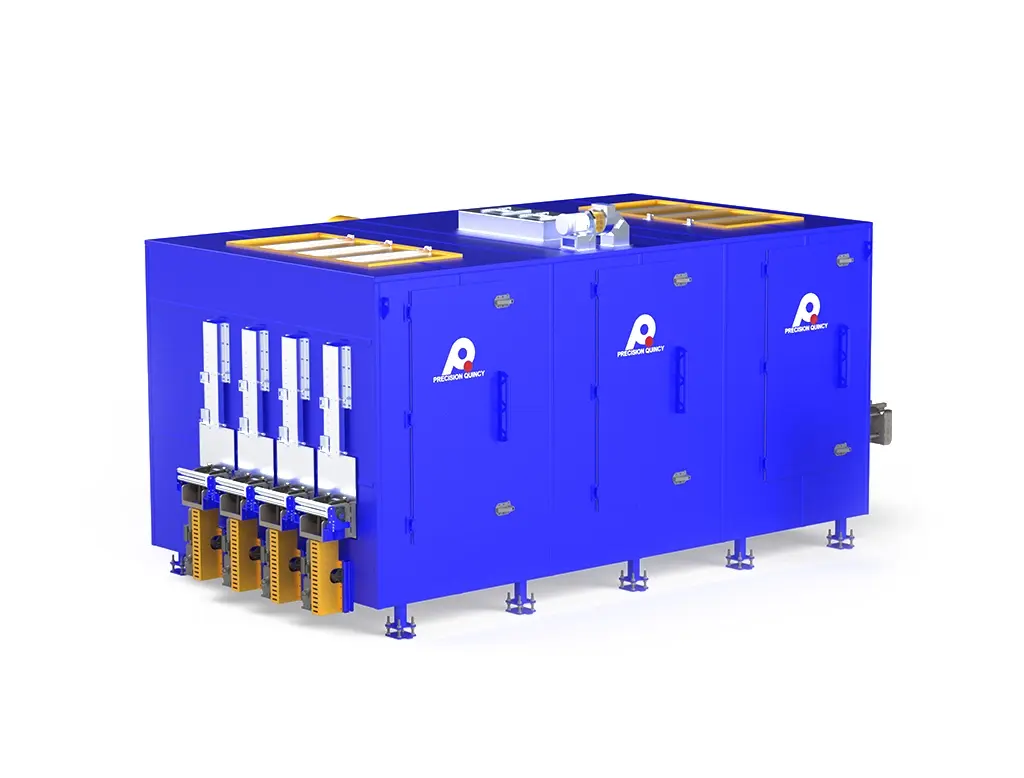
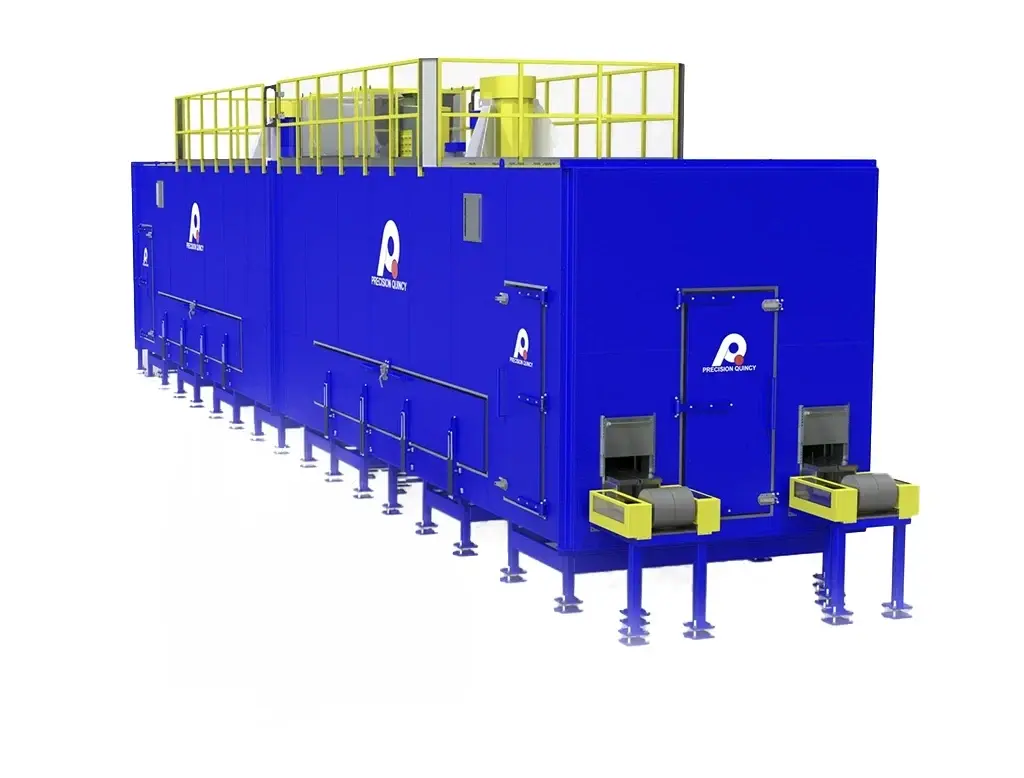
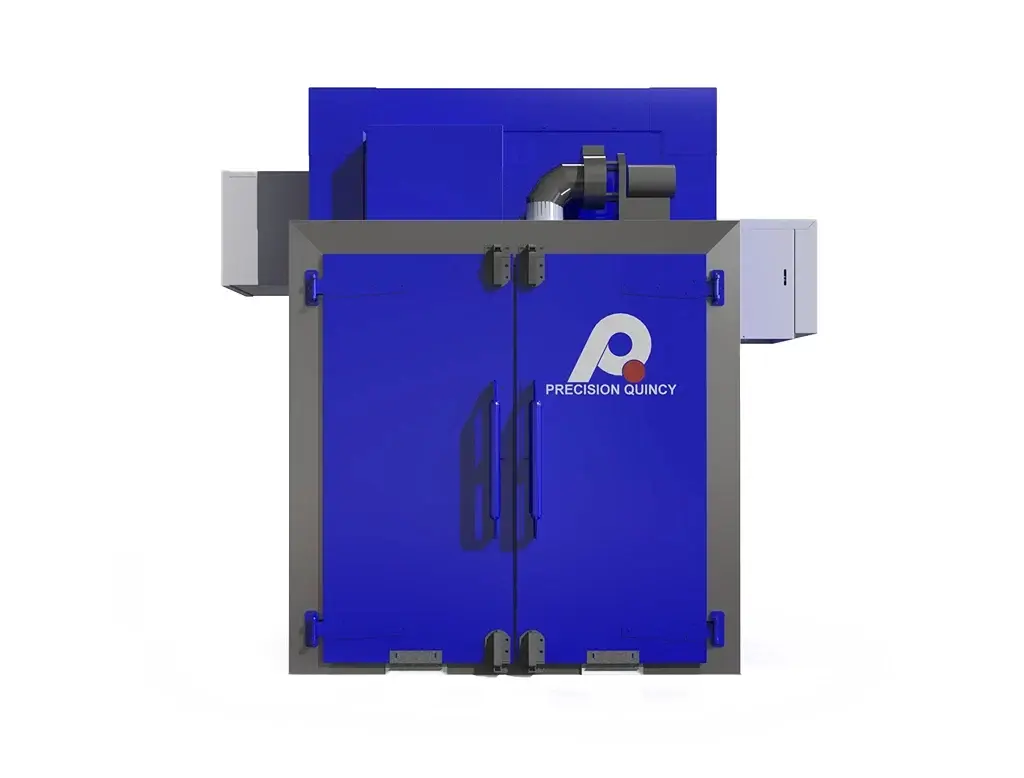
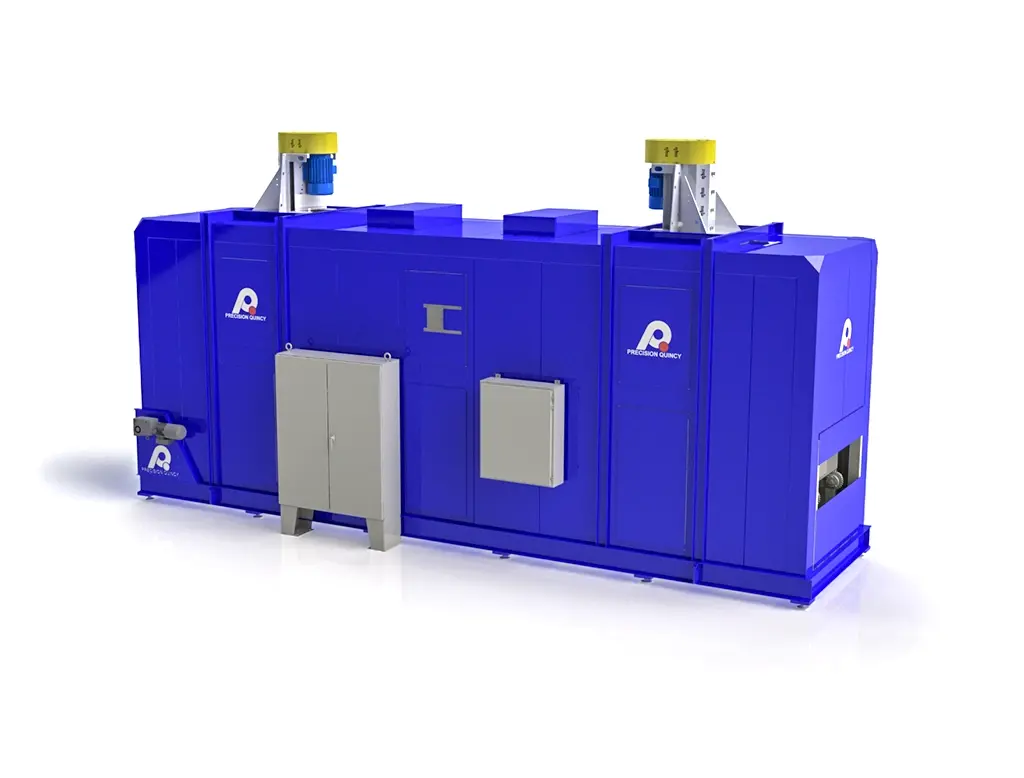
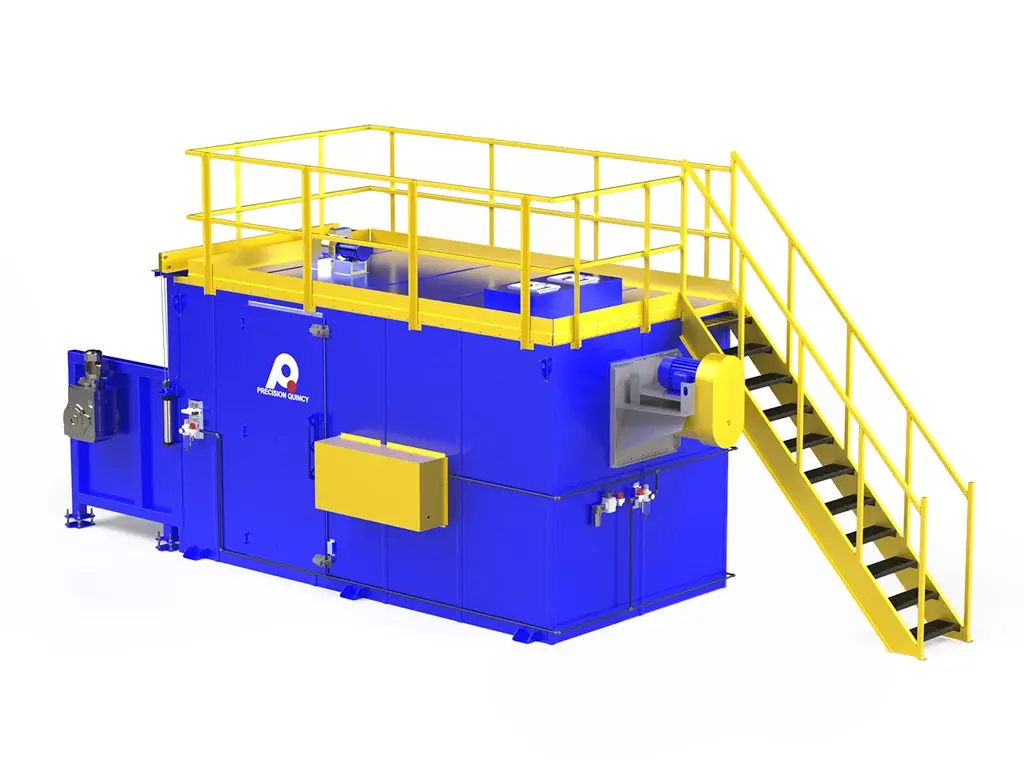
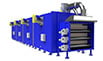
Five-Station Foam Gasket Outgassing Oven for Insulating Glass Foam Spacer/Gasket Processing
Key Takeaways
- Engineered a five-station batch-indexing outgassing oven with five independently controlled heat zones
- Validated ≤50°F spread after 17 min heat-up and ≤20°F spread at process condition, using ~15–20 embedded foam thermocouples
- Replaced failure-prone wheel-based cart movement with closed-loop servo-driven chain conveyance
- Reduced footprint by condensing carts during processing and separating only during door cycles
- Integrated NFPA 86 Class-A safety architecture for VOC off-gassing control
- Solved for facility air constraints
In thermal processing, sometimes reliability can be a bottleneck.
You can define temperature. You can define dwell time. But if the system can’t move product consistently through the oven, everything else becomes secondary. When carts bind, when you have to cool down to fix a jam, or when recovery after a door cycle is unpredictable, you’re reacting to issues instead of running a controlled process.
On this project, the outgassing process itself wasn’t new. We’ve built equipment for iterations of this application for a global insulating glass components manufacturer going back decades.
This time, the thermal process wasn’t the issue. The challenge was engineering a batch-indexing oven system that could reliably move heavy steel carts loaded with foam gasket reels without daily stoppages and within the footprint of the existing facility.
The Challenge
Our customer needed a high-capacity outgassing solution for foam gasket reels used in insulating glass assembly. Each loaded steel cart weighs approximately 2,000 lbs., with roughly 95-98% of that mass being the steel cart structure, not the foam. The system needed to:
-
Maintain ±10°F temperature uniformity
-
Use natural gas indirect-fired heating
-
Provide mixed-direction high-volume airflow (vertical-up, vertical-down, and side nozzles in Zone 1; round nozzles in Zones 2-5)
-
Automate cart handling for repeatable throughput
-
Meet NFPA 86 Class-A requirements
-
Fit inside an existing production footprint
But the real driver was reliability.
A previous automation approach dragged carts through the oven on their own wheels. On paper, it was simpler. In practice, it bound up daily. When this happened, the production team had to cool the oven, remove partially processed foam, extract the stuck cart, and restart. Every occurrence cost one to two hours of production and adversely impacted margin.
In an outgassing application where incomplete VOC removal can create downstream quality risk, unpredictability isn’t acceptable.
Throughput mattered. Safety mattered. But reliability was the tipping point. This build became about restoring control to the conveyance, airflow, and production schedule.
Scaling a Proven Process for Continuous Operation
Outgassing is required to drive off volatile organic compounds (VOCs) retained in the foam from upstream salt-bath manufacturing. If they aren’t fully removed before the gasket is installed in a sealed window unit, they can off-gas inside the window cavity and cause hazing or fogging in the field. In essence, the oven is both a thermal processor and a quality gate.
The process required:
-
Bringing high-mass foam product up to temperature in a controlled ramp phase
-
Holding temperature long enough to fully drive off VOCs
-
Managing airflow to ensure uniform heating across dense loads
-
Exhausting vapors safely while maintaining negative pressure
At the same time, the oven system had to be engineered around the building and footprint it was going into, not the other way around.
The engineering approach
Our team was tasked with determining how to treat conveyance, zoning, and exhaust as one integrated system rather than isolated features or afterthoughts.
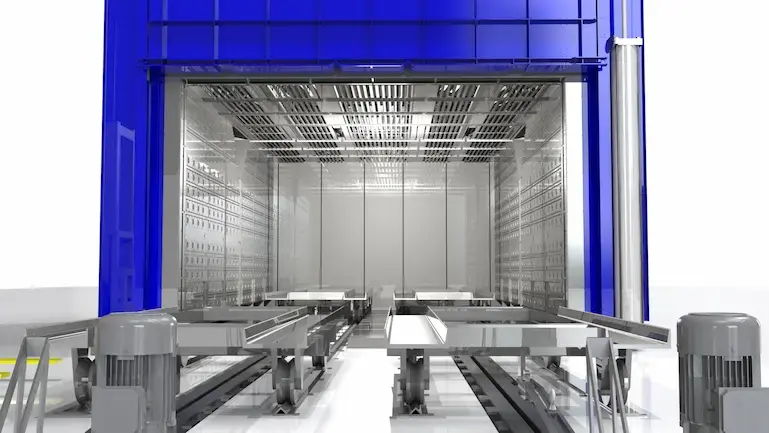
Instead of relying on the carts’ transport wheels, we engineered a servo-driven chain conveyance system. Each side operates on independent closed-loop servo motors, electronically synchronized to maintain precise indexing. Carts are side-loaded via pallet jack onto engineering chain and transferred by a pusher/extractor arm into the indexed conveyor sequence. [NOTE: AR-400/500 steel rails not confirmed in case study — verify or remove before publishing].
It also enabled something critical for this facility: by using three mechanically independent conveyor sections, the indexed cart spacing could be managed within the oven body. During load and upload cycles, the system sequences conveyors to create just enough separation for door clearance.
Motion was a priority, but engineering the system to run without binding was paramount.
Project at a glance
-
Application: Outgassing VOCs from foam gasket reels before insulating glass assembly
-
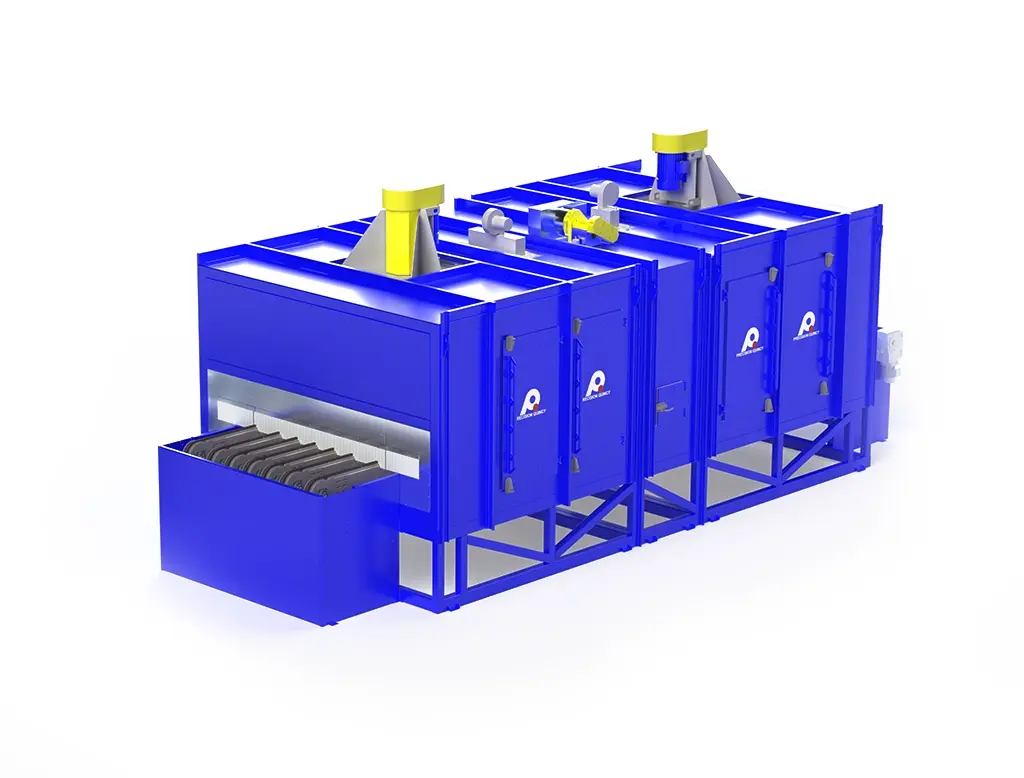
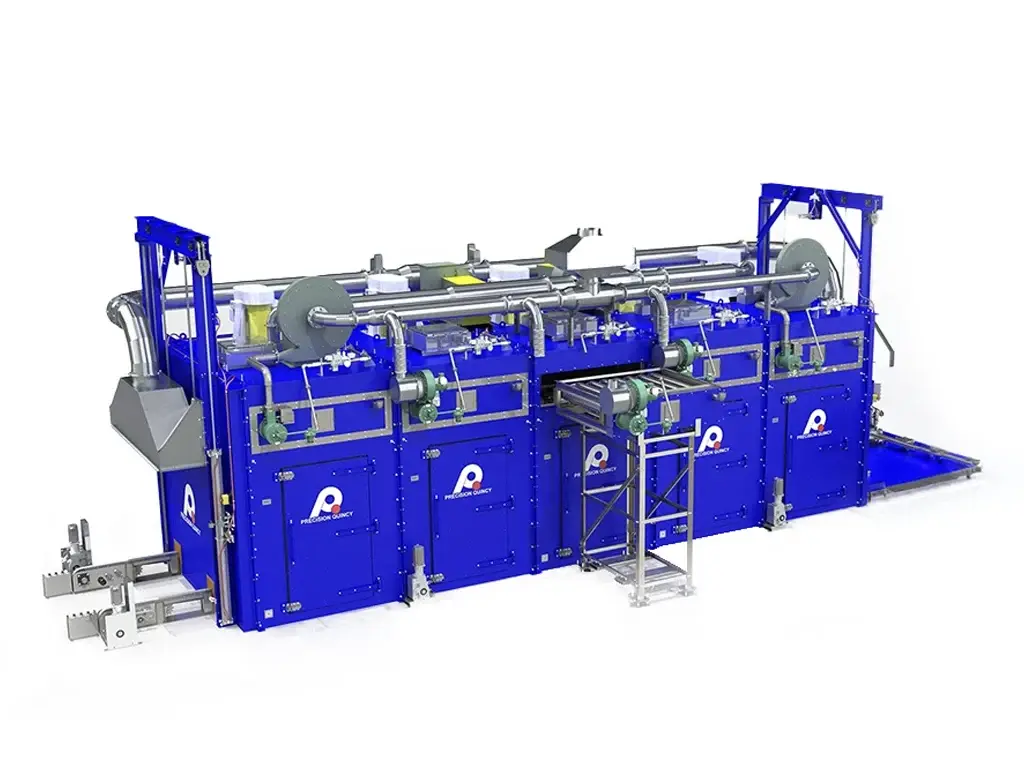
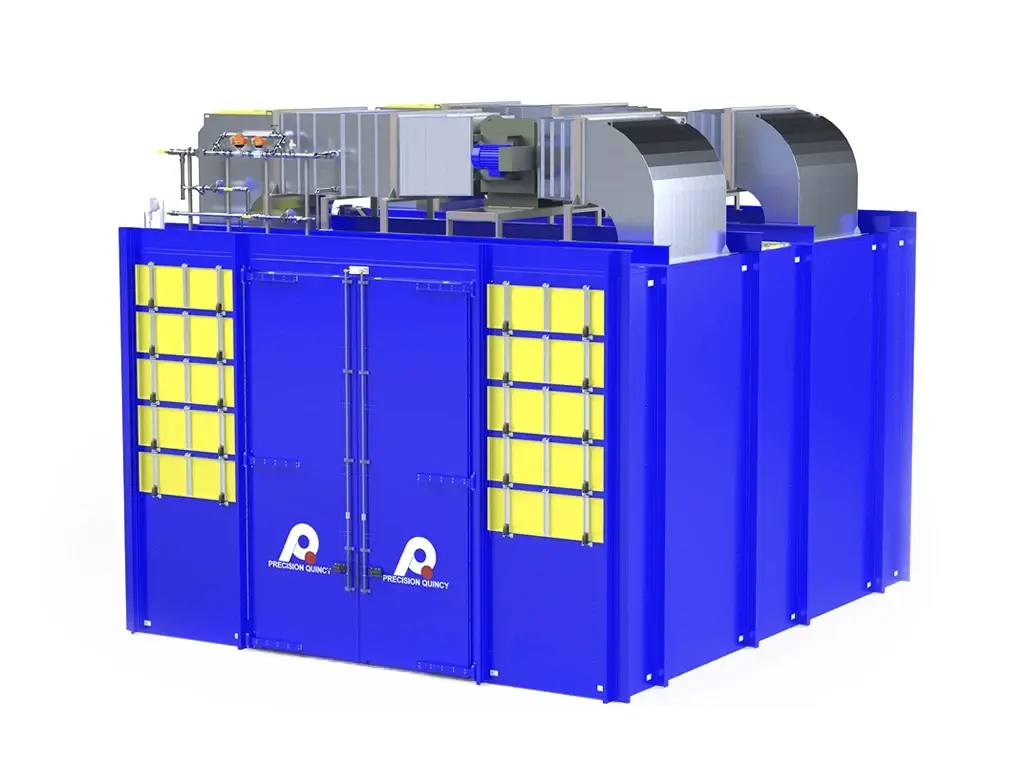
System: Five-station batch-indexing outgassing oven
-
Throughput: One cart every 30 minutes
-
Capacity: ~2,000 lb per cart (~95–98% steel cart structure, not foam)
-
Uniformity: ≤50°F spread after 17 min heat-up; ≤20°F at process condition (embedded foam thermocouples)
-
Heating: Natural gas, indirect-fired burners
-
Airflow: Zone 1: ~13,700 CFM; Zones 2–5: ~10,250 CFM each
-
Conveyance: Three servo-driven sections: 86.25 in. infeed, 204.5 in. heated middle, 124 in. outfeed (437.75 in. total)
-
Automation: Pusher/extractor transfer arm; carts side-loaded via pallet jack at ~66.5 in. load station
-
Compliance: NFPA 86 Class-A
-
Exhaust: 2,000 CFM process exhaust (400 CFM/zone); 3,000 CFM hood exhaust (door-open events only)
Execution & Integration
Engineering performance is one thing. Making that performance repeatable under real production conditions is where execution and integration define success.
Five Zones, Controlled as One System
Each oven includes five independently controlled zones.
The first zone functions as a ramp zone. It delivers higher airflow and energy input to bring dense foam reels to temperature quickly and consistently.
The remaining zones function as soak zones, holding temperature long enough to fully drive off VOCs without overheating the high-mass foam.
Because door cycling introduces cold air infiltration at the ends, the two end zones are designed with greater heat density to recover quickly and maintain profile stability.
Across the five-zone oven (72 in. per heated zone, 360 in. total heated length, 86.5 in. door opening width), the system delivers its validated temperature spread: ≤50°F after 17 min heat-up and ≤20°F at process condition, based on ~15–20 embedded foam thermocouples. Zone 1 delivers ~13,700 CFM; Zones 2–5 deliver ~10,250 CFM each.
This wasn’t five heaters. It was a managed thermal progression.
Indirect Heating for Process Integrity
Because combustion byproducts cannot mix with the foam being outgassed, every burner is indirect-fired. Each zone includes a slide-out side-service heat exchanger, withdrawable via a support rail for inspection or removal without major disassembly. That’s a long-term reliability decision.
Safety Built Into Operation
VOC off-gassing requires controlled exhaust and negative pressure. The system includes:
-
Vertical lift pneumatic doors with automatic safety locks
-
Door catch systems to prevent fall risk
-
Blower proving switches and over-temperature protection
-
Controlled exhaust strategy tied to door cycles
Automation minimizes operator interaction from load to unload, reducing strain and exposure to heat.
Solving Facility Air Constraints
The facility had limited building air makeup capacity. Instead of pulling process air from inside the building, which can create pressure instability, we engineered the system to:
-
Draw combustion and fresh air from outside
-
Filter intake air
-
Sequence exhaust hoods so they operate only when doors open
-
The oven was designed to integrate with the building, not disrupt it.
Results
This system delivered measurable operational impact:
-
Eliminated daily binding events tied to wheel-based conveyance
-
Restored predictable, continuous throughput
-
Restored reliable, predictable throughput at one cart every 30 minutes
-
Maintained ±10°F uniformity across heavy, dense batches
-
Improved operator safety through automation
-
Reduced scrap and quality risk by stabilizing the curing profile
The difference showed up in performance and consistency.
Closing Thoughts From the Build
In thermal processing, it’s easy to talk about airflow, zone counts, or burner capacity. Those numbers matter. But for us, performance means something more specific: the system runs the same way on the plant floor as it did in the build spec.
On this project, the chemistry wasn’t new. The temperatures weren’t extreme. The real challenge was making the system reliable under real production conditions. When you’re moving heavy steel carts loaded with foam gasket reels and driving off flammable VOCs, predictability matters. Conveyance has to index correctly. Doors have to cycle and recover consistently. Exhaust has to manage vapor safely. If any one of those drifts, you feel it immediately.
What we’re most proud of in this build is that it isn’t focused on a single component. It’s how the motion system, zoning strategy, airflow, and safety architecture work together as one managed process. Collectively, it’s what allows production to move forward without daily downtime or guesswork.
Solutions like this reflect how we approach engineering at Precision Quincy: disciplined in the details, realistic about plant conditions, and focused on equipment that performs reliably long after installation.
If you’re working through a curing or thermal processing challenge, our team is always ready to talk through requirements, constraints, and what “predictable at production scale” needs to look like for your operation.
You May Also Like
These Related Stories

Building the Better Clown Car: Computational Fluid Dynamics Leads to Better Industrial Oven Design
Precision Quincy’s Advanced Control Oven Enhances Fiberglass Roll Processing