


Insulated Panel Construction
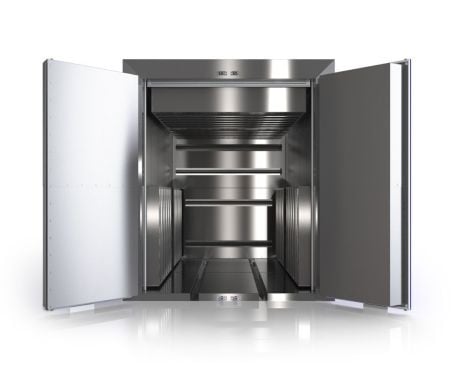
In this approach, the insulated panel itself serves as both the insulated barrier and a structural element. Because the inner steel skin runs at a higher temperature than the outer skin, the panel behaves like a bimetal spring as the oven heats up — the inner surface wants to expand more than the outer surface, which can cause panel warping. Additional structural steel is often added to control that warping.
This creates a fundamental tradeoff: the same panel is being asked to provide insulation and carry structure. Modifying the connecting geometry between inner and outer skins can reduce thermal-growth forces, but may also weaken the panel structurally. Insulated panel construction is most attractive for lower-temperature and lower-cost applications, especially when the oven is not extremely large. Panels can often be shipped flat-packed for efficient field assembly.
Can-Constructed Shells
In can-constructed ovens, the inner and outer shells are more independent from each other. The outer structure supports the external shell and major equipment such as fans, heat systems, and exhaust devices. Inner liners or pans typically support the insulation load, connected at structural boundaries like the base, perimeter framing, or door areas. This creates a different load path than insulated panels — the inner liner system carries much of the insulation weight rather than the panel acting as a single combined structural-insulated member.
Supported-Cladding / Semi-Can Construction
A variation where an outer structural shell or frame carries the primary load while interior cladding mainly protects the insulation from the oven air stream. The inner cladding is attached through stand-offs, pins, or other features that allow thermal movement. This reduces the need for the inner liner system to carry the entire insulation load from above — related to can construction, but with a different load path and thermal-growth strategy.
Pin-Style Construction
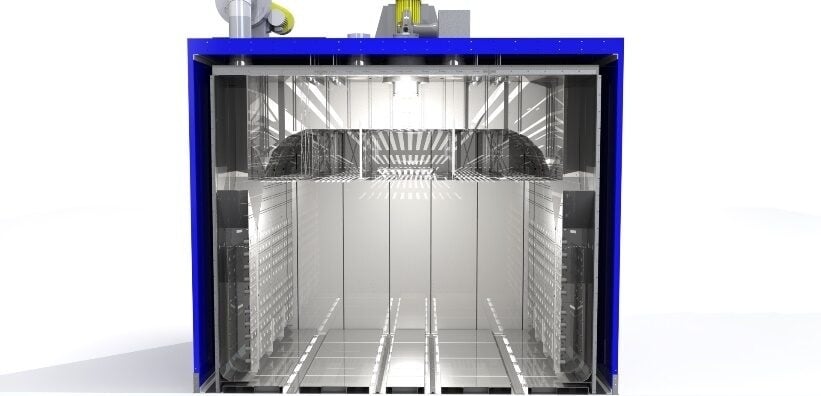
The outer shell or structural frame carries the main load. The inner cladding is not a major structural element — its purpose is to protect the insulation from erosion or damage caused by recirculation airflow. The cladding is divided into smaller overlapping sections so it can expand and contract freely, attached by pins at intervals back to the outer structure. This approach makes thermal growth much easier to manage and is generally much less sensitive to large-scale warping than insulated panels. Pin-style construction can also allow future re-insulation or cladding replacement. In many larger or hotter oven applications, this is one of the more robust approaches.
Ceramic Fiber Module / Furnace-Style Construction
Structural outer framing with ceramic fiber modules attached to the inside of the shell using studs. The modules are often exposed to the interior unless a protective mesh or rigidizer is applied. More similar to furnace construction. In convection applications, airflow management or protective measures may be needed to reduce erosion of the exposed insulation. Like pin-style, the outer shell carries the structural load, so differential inner-versus-outer growth is less of a system-level problem.
General Tradeoff Principle
Constructions where the outer structure carries the load and the inner thermal barrier can move independently tend to scale better as ovens become larger or hotter. Pin-style and ceramic-fiber-module constructions can both reduce expansion and contraction problems compared with systems where the hot inner and cooler outer skins are rigidly tied together.
Pressure-Shell Consideration
In some pressurized duct or heat-chamber sections, it may make sense to place the heavier structural shell on the hot side and wrap insulation around the outside of that pressure shell. This can be structurally advantageous for certain ducted sections, but if the hot inner shell is rigidly fixed to surrounding structure, thermal growth must be managed carefully with sliding supports, expansion joints, and other provisions.